
Is Ketamine Therapy Covered by Insurance?
| INSURER | Spravato® for Depression | IV Ketamine for Depression | Injection & Oral/Sublingual Ketamine | Real-World Notes & “Gotchas” |
|---|---|---|---|---|
| Large Employer & ACA (Obamacare) Plans | Widely covered with prior authorization | Rarely covered for depression | Almost never explicitly covered | In a 2025 review of 18 major commercial insurers, all had a written policy covering Spravato for depression, nearly always with prior authorization (failed ≥2 antidepressants, qualifying diagnosis, certified/REMS clinic). Only one clearly covered IV ketamine for depression. IM and oral/sublingual ketamine typically live in a gray zone; most patients end up paying cash even if they submit claims. |
| State Medicaid Plans | Mixed: some states cover, others are silent | Generally not covered for depression | Not covered / “silent” (functions as no) | Some state Medicaid formularies list Spravato with strict criteria and heavy paperwork; others either exclude it or never mention it. For IV, IM, and oral ketamine, policies for depression are usually a clear “no” or not addressed at all. In practice, “not addressed” behaves like a denial unless a rare exception is granted on appeal. |
| Traditional Medicare (Part B) | Covered on paper; access limited by local clinics | Not clearly covered for depression | Not covered as a depression treatment | Medicare can pay for Spravato when delivered in a certified clinic that bills under the correct J-codes and site-of-care rules. But real-world billing data show some states with no clinics actually billing Medicare for Spravato, even though it’s technically covered. IV/IM/oral ketamine for depression remain off-label, and there is no clear Part B path to routine reimbursement. |
| Veterans Health Administration (VA) | Covered at select VA sites for eligible veterans | Available at select VA Medical Centers | Limited; mainly research/consultative use | The VA is its own health system, not a commercial insurer. For eligible veterans with treatment-resistant depression or PTSD, the VA can cover Spravato and IV ketamine at certain VA hospitals/clinics under strict protocols (failed ≥2 first-line antidepressants, mental health evaluation, monitoring). If your local VA doesn’t offer ketamine, you may be sent to a private clinic through the VA Community Care Program, with the VA paying the bill. Veterans do not use Humana, Cigna, etc. for VA-authorized ketamine—everything runs through the VA. |
How to Read This Coverage Table
Green cells mean coverage is common but not automatic (expect prior auth and bureaucracy). Amber cells signal spotty or site-dependent coverage. Red cells mean you should plan on cash-pay unless your insurer or VA team makes an unusually generous exception.
Big-Picture Takeaway
For depression, Spravato is still the most realistic path to insurance- or VA-covered ketamine treatment across commercial plans, Medicaid, Medicare, and the VA. IV, IM, and oral/sublingual ketamine remain mostly cash-pay or confined to specific VA centers and research programs, with only rare, case-by-case coverage exceptions.
Evidence-Based Guide:
Every claim in this guide is backed by Medicare, Medicaid, VA, and independent research sources listed in the References section at the bottom of the page.
By Michael Alvear, Health Author & Independent Researcher
My research is published on these scholarly platforms:

Last Updated:
Does Insurance Cover Ketamine Therapy?
In practice, insurers overwhelmingly pay for one thing: Spravato® (esketamine nasal spray). A smaller group of eligible veterans can also get IV ketamine covered at certain VA centers. Outside that, getting IV, injection, or oral/sublingual ketamine covered by commercial insurance, Medicaid, or Medicare is still rare to non-existent.
✓
The One Treatment Most Plans Actually Cover
- Spravato® (esketamine nasal spray) is the ketamine-based treatment most likely to be covered across large commercial plans, many Medicaid plans, Medicare, and the VA (if you’re eligible). Find out how much Spravato will cost you and how many sessions you’ll need.
- Coverage almost always comes with strings attached: prior authorization, proof you’ve failed other meds, a qualifying diagnosis, and treatment in a certified clinic that knows how to bill it.
- IV / IM / oral ketamine for depression remain mostly cash-pay or limited to specific VA or research settings, with only rare exceptions in commercial or public insurance. Find out how much these ketamine therapies will cost you.
◐
Employer & ACA (Obamacare) Plans
- In my 2025 review of 18 of the largest commercial insurers, every single one had a written policy that covers Spravato for depression.
- Almost all require prior authorization: you’ve failed other antidepressants, have a specific diagnosis, and receive treatment in a certified clinic.
- IV ketamine infusions: only one of those 18 insurers clearly covered them for depression.
- IM ketamine injections and oral/sublingual ketamine: no explicit coverage in those policies. Most people trying to get these covered end up in a gray zone—or paying cash.
?
Medicaid & Medicare
- Medicaid: Some state Medicaid plans cover Spravato (again, with strict rules and paperwork). Others either don’t cover it or never mention it at all.
- IV, IM, and oral ketamine under Medicaid: written policies for depression are usually a clear “no” or simply silent—which, in practice, usually behaves like “no.”
- Medicare: Traditional Medicare can pay for Spravato when it’s given in a certified clinic that knows how to bill it.
- In my analysis, several states had no clinics billing Medicare for Spravato at all, even though it’s covered on paper. IV, IM, and oral ketamine are not clearly covered as depression treatments under Medicare.
!
Veterans (VA): A Separate System With Different Rules
The VA is its own health system, not a commercial insurer. For eligible veterans with treatment-resistant depression or PTSD, the VA can cover:
- Spravato (esketamine) at certain VA hospitals and clinics.
- IV ketamine infusions at select VA Medical Centers, under strict protocols and monitoring.
- Coverage is case-by-case and usually requires a VA mental health provider evaluation and proof you’ve failed at least two first-line antidepressants.
- If your local VA doesn’t offer ketamine, you may be referred to a private clinic through the VA Community Care Program, where the VA still pays the bill. Veterans do not use Humana, Cigna, or other commercial plans for VA-authorized ketamine; everything runs through the VA’s own system.
Bottom line: Spravato is the treatment most likely to be covered by commercial insurance, many Medicaid plans, Medicare, and the VA. IV, IM, and oral ketamine are still mostly cash-pay or limited to specific VA or research settings, with only rare exceptions.
The rest of this guide breaks coverage down by insurance type and shows you how to check your own benefits, talk to your plan (or VA provider), and plan for costs if you’re told “we don’t cover that” or “we don’t have a policy.”
↓
Click any card in the table of contents below to skip straight to your insurance type.

Can’t Decide Between IV, Injections, Or Spravato?
Use My Decision Table
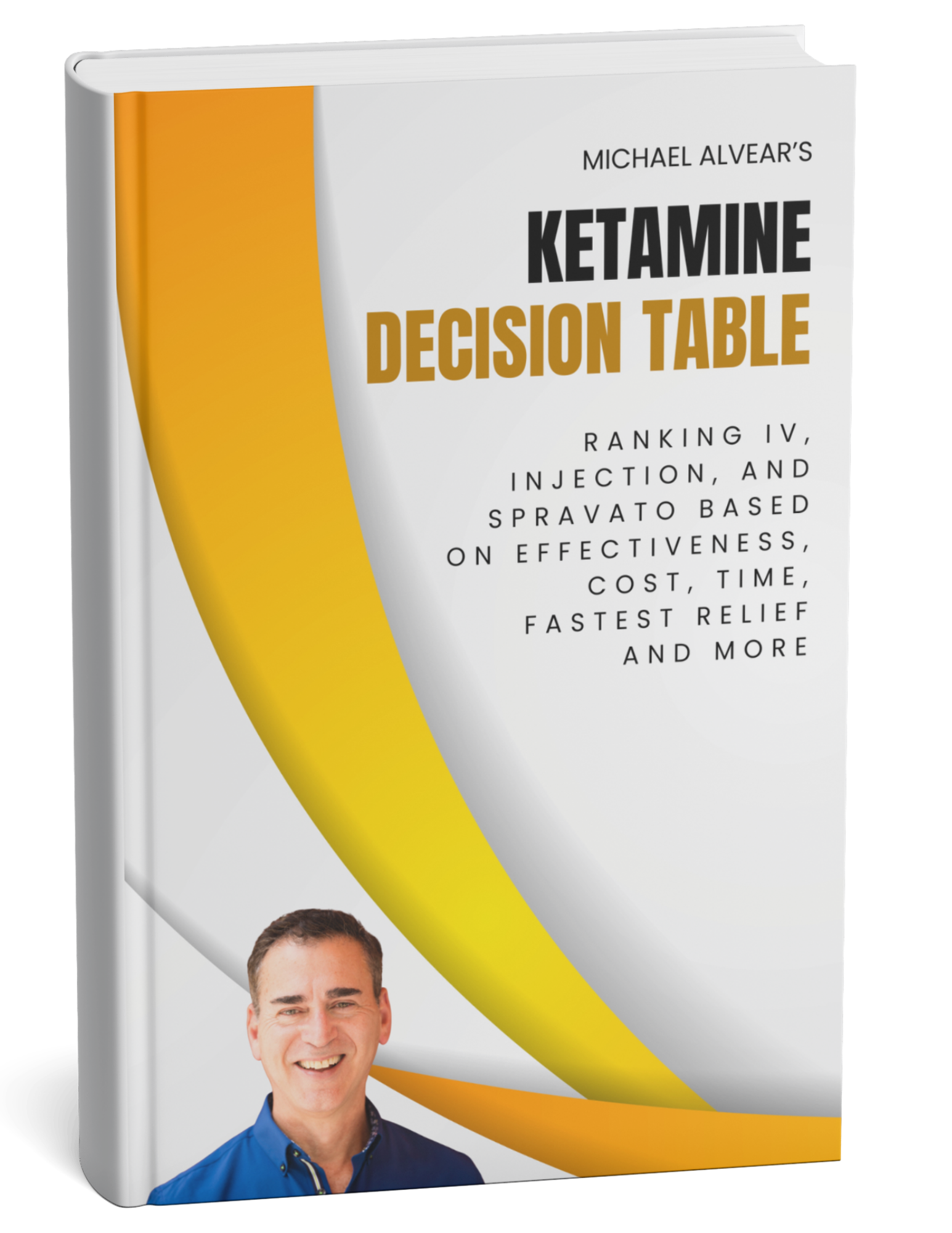
This report ranks all three options—IV, injection, and Spravato—on effectiveness, cost, fastest relief, and more, giving you a clear framework to decide.
Downloads as PDF • 5 minute read

Types of Ketamine Treatment: Spravato vs IV vs Oral Ketamine Insurance Coverage
Spravato® (esketamine nasal spray)
- What it is: A branded nasal-spray version of ketamine’s “cousin” (esketamine).
- How it’s given: You come to a certified clinic, spray it under supervision, and stay for monitoring (usually 2+ hours). You never take it home.
- What it’s approved for: Treatment-resistant depression (and, in some cases, depression with suicidal thoughts).
- Why insurance treats it differently:
- It has a specific FDA approval for depression.
- It has a formal Risk Evaluation and Mitigation Strategy (REMS) program and defined billing codes.
- As a result, commercial insurers, Medicaid, Medicare, and the VA are all far more likely to have written coverage policies for Spravato than for any other ketamine route.
IV ketamine infusions
- What it is: Standard ketamine given through a vein (an IV drip) over about 40–60 minutes.
- How it’s given: Usually in a clinic or hospital setting, with monitoring during and after the infusion.
- What it’s used for: off-label treatment for depression, PTSD, and some pain conditions. “Off-label” means the drug is FDA-approved, but not specifically approved for that use.
- Why insurance is hesitant:
- There is no FDA indication for depression with IV ketamine.
- Many insurers label it “investigational” or simply never mention it in their policies.
- In my review of large commercial insurers, explicit coverage for IV ketamine for depression was the rare exception.
- VA angle: The VA has formal IV ketamine protocols at some VA Medical Centers for treatment-resistant depression and PTSD. These are tightly controlled: case-by-case approval, strict criteria (for example, failure of multiple antidepressants), and close monitoring. Outside the VA system, coverage is far less common.
IM ketamine injections
- What it is: Ketamine given by injection into a muscle (usually thigh or shoulder), instead of a vein.
- How it’s given: Typically in a clinic with monitoring during and after.
- What it’s used for: Off-label treatment for depression and sometimes PTSD or pain.
- Why insurance is even more hesitant here:
- Like IV, IM ketamine has no FDA depression indication.
- Many insurers don’t have a specific policy for it at all; others lump it under “not covered for psychiatric use.”
- In my commercial insurer review, there were no explicit IM ketamine coverage policies for depression.
- VA angle: Some VA centers may use IM ketamine in specific cases, but the clearer, more standardized protocols tend to be for IV infusions and Spravato, not routine IM shots for depression.
Oral / sublingual ketamine (lozenges, troches, rapid-dissolve tablets)
- What it is: Ketamine that’s swallowed or held under the tongue/inside the cheek to absorb through the mouth.
- How it’s given: Often prescribed for at-home use or taken in a clinic, depending on the provider.
- What it’s used for: Off-label treatment for depression, PTSD, and some pain conditions.
- Why insurance is very hesitant:
- No FDA approval for depression. Plus, the FDA has issued warnings about the risks of at-home ketamine therapy.
- Many insurers don’t specifically mention oral/sublingual ketamine for mental health at all, or they explicitly call it not covered / investigational.
- In my commercial insurer review, there were no oral/sublingual ketamine policies written for depression.
- VA angle: Most VA ketamine programs focus on Spravato and IV infusions. Oral/sublingual ketamine for depression is rare in the VA system and not part of standardized, national protocols.
Why these differences matter so much: These aren’t just clinical details – they’re the central reason people get totally different insurance answers depending on which ketamine route they’re asking about. Ask about Spravato → “Yes, but you need prior authorization and meet strict criteria.” Ask about IV ketamine → “No, we consider that investigational,” or “We don’t have a policy on that.” Ask about oral/sublingual ketamine → “No, we don’t cover that for depression,” or “We have no coverage position.”
Got Questions? Ask Me Directly.

I personally read and respond to every email within 48 hours.
How Insurance Companies Decide Ketamine Coverage: Prior Authorization Explained
1. Coverage policies and medical policies
Every major insurer has a set of written documents called medical policies or coverage policies that say what treatments they cover, under what conditions, and for which diagnoses.
These policies are usually publicly available (though sometimes hard to find), and they look like this:
- Treatment / drug name (e.g., “esketamine (Spravato)” or “IV ketamine”).
- Indications (e.g., treatment-resistant depression, suicidal ideation).
- Criteria (e.g., “after failure of at least two antidepressants from different classes” or “must be given in a certified, in-network clinic”).
- Exclusions or experimental labels (e.g., “IV ketamine for depression is considered investigational and not covered”).
When your doctor submits a prior authorization (prior auth) request, a reviewer looks at your case against the written policy. If your situation matches the criteria, approval is usually straightforward. If it doesn’t match or if there’s no policy at all, you’re in denial or gray-zone territory.
2. Prior authorization – how hard they make you and your clinician prove it
For treatments like Spravato that are covered, almost all insurers require prior authorization before your first dose. This is essentially:
- A formal request your doctor submits before you get treatment.
- A review process where the insurer (or a third-party company they hire) checks whether you meet the policy’s criteria.
- A yes/no answer that usually comes back within a few days to a couple of weeks.
You typically need to show:
- Diagnosis code (like treatment-resistant depression, ICD-10 code F33.2 or similar).
- List of medications you’ve tried and failed, including dosages and durations.
- Notes from your doctor explaining why you meet the policy’s definition of “treatment-resistant.”
3. Network and site-of-care rules – which clinics or hospitals they’ll pay, and how
Even when a treatment is “covered,” insurers don’t necessarily pay every clinic that offers it:
- In-network vs out-of-network: In-network means the insurer has a contract with that clinic or hospital; they agree on rates and billing methods. Out-of-network means no contract – sometimes the insurer won’t pay at all, sometimes they’ll pay a small fraction and you’re left with the rest of the bill.
- Site-of-care requirements: Some insurers only cover Spravato if it’s given in a hospital outpatient setting, not a standalone clinic. Others require clinics to be certified through the manufacturer’s REMS program.
For veterans in the VA, this works differently. The VA doesn’t have “in-network clinics” the way commercial insurance does. Instead, if the VA offers ketamine at your local VA Medical Center, you get care there. If the VA doesn’t offer it locally, you might get referred through the VA Community Care Program, where the VA pays an outside clinic directly.
4. Labels like “experimental” – especially for IV, IM, and oral ketamine
When insurers don’t have a clear policy for a treatment, they often default to one of these labels: Investigational, Experimental, Not medically necessary, or Not covered for this diagnosis. In practice, these all mean the same thing: we’re not paying for this.
This is where IV, IM, and oral ketamine for depression often land. Because they don’t have FDA approval for depression, many insurers say: “We’re not denying it exists. We’re just not covering it for psychiatric use because we consider it investigational.”
When there’s “no policy” (the gray zone): Sometimes the answer you get from an insurer is “We don’t have a policy on that.” That’s not the same as “no,” but in practice, it often functions the same way. Clinics don’t want to bill for something when they don’t know whether the insurer will pay, patients don’t want to risk a giant bill after the fact, and doctors are left trying to submit case-by-case prior auth requests that often get rejected or sit unanswered for weeks.
Commercial Insurance Ketamine Coverage: Employer Plans, ACA, Blue Cross, Cigna, Aetna
Spravato: written into almost every big insurer’s rulebook
In this 18-insurer sample:
- All 18 insurers had a written policy that covers Spravato® (esketamine nasal spray) for depression.
- Almost all of them required prior authorization – in plain English, your clinician has to prove you have a qualifying diagnosis, have tried and failed a certain number of antidepressants, and are getting Spravato in a certified clinic that meets monitoring requirements.
Even when it’s “covered,” Spravato is rarely a simple yes/no. It’s more like: “Yes, but only after you jump through these hoops, at these locations, under these conditions.” From a patient’s standpoint, that usually means paperwork, delays, and back-and-forth between the clinic and insurer before sessions begin.
IV ketamine: one clear “yes,” many gray zones
For IV ketamine infusions for depression, the pattern is completely different:
- Among the 18 insurers I examined, only one had a clear, written policy that explicitly covered IV ketamine for depression.
- Several others had language that applied to ketamine only as an anesthetic or pain drug (for surgery, certain pain conditions, etc.), not as an antidepressant.
- Many policies simply never mentioned IV ketamine for depression at all.
That last group — “we don’t say anything about it” — creates enormous uncertainty. In practice, those plans tend to behave like a soft no: phone reps give mixed or incorrect answers, clinics don’t know whether to bother with prior auth or just warn you it’s cash-pay, and claims that do get submitted are often denied.
IM and oral ketamine: no explicit coverage in the big-insurer sample
For IM ketamine injections and oral/sublingual ketamine (troches, lozenges, rapid-dissolve tablets):
- In this 18-insurer dataset, none had explicit coverage policies for these routes when used to treat depression.
- When they were mentioned at all, it was usually as anesthetic drugs for surgery, or as “investigational/experimental” for psychiatric use.
Policy silence: the hidden problem. One of the most important findings is not just the handful of yeses and noes, but the huge amount of policy silence around off-label ketamine. For IV, IM, and oral ketamine, a large share of insured people are in plans where the policy never actually says “yes” or “no” for depression. That silence shifts all the burden onto the patient, the clinic, and individual reviewers—making it feel like “we don’t cover it,” even if the policy technically never said the words.
Does Medicaid Cover Ketamine Therapy? State-by-State Coverage Guide
Two layers: state rules and plan rules
Here’s how Medicaid is built for most people:
- The state Medicaid program sets the big picture rules.
- The state then pays private companies to run day-to-day care through Medicaid managed care plans (MCOs).
That means your state might allow Spravato or other ketamine treatments in theory, but your specific plan inside that state can still have its own, very different policy.
Think of it like this: your state is the building, your plan is the locked door. You only get care if your plan’s door actually opens.
Spravato on Medicaid: a patchwork of yes, no, and “we don’t say”
In my state-by-state Medicaid research, I found a mix of patterns:
- Some states have multiple Medicaid plans that cover Spravato for treatment-resistant depression (always with prior authorization).
- Some states have only one Medicaid plan that covers Spravato; people in the other plans are out of luck unless policies change.
- Some states have no plan that clearly lists Spravato for depression at all; the drug might appear only as a hospital anesthetic or not appear in mental-health policies.
Even when Spravato is covered, plans usually require a qualifying diagnosis, proof you’ve tried and failed multiple antidepressants, treatment in a certified in-network clinic, and prior authorization before the first dose.
IV, IM, and oral ketamine: usually “no” or not mentioned
For IV ketamine, IM injections, and oral/sublingual ketamine, the Medicaid picture is much harsher:
- Many plans explicitly list these routes as not covered for depression or PTSD (often calling them “experimental” or “investigational”).
- Others simply never mention them as mental-health treatments; they only appear in anesthesia or pain sections.
In real life, that almost always functions as a no: clinics tell patients it’s cash-pay, prior auth requests are denied or never even accepted, and appeals rarely succeed because there’s no positive policy to lean on.
Why two people in the same state can get totally different answers: Because each Medicaid plan inside a state can write its own policy, you can easily see situations like Person A on Plan 1 gets Spravato approved after prior auth, while Person B on Plan 2 in the same state is told “we don’t cover that” or “we have no policy.” That isn’t a mistake; it’s how Medicaid is designed.
Does Medicare Cover Ketamine Treatment? Original Medicare vs Medicare Advantage
How Spravato is supposed to work under Medicare
For traditional Medicare (Part B), Spravato is treated like a clinic-administered treatment: You go to a certified clinic or hospital outpatient department, they give you Spravato, monitor you for a couple of hours, and bill Medicare using specific codes. If Medicare accepts the claim, it usually pays around 80% of the approved amount; you or your supplemental coverage pay the rest.
On paper, that sounds straightforward: “If I have treatment-resistant depression and a willing clinic, Medicare should help pay.” In reality, two things can still block you: no local clinic willing to bill Medicare, and Medicare Advantage plans with their own extra rules.
State-by-state reality: treatment deserts
When I looked at national Medicare billing data for Spravato, I saw a striking pattern: some states had multiple clinics or hospital systems billing Medicare for Spravato, while other states had no clinic-billed Spravato activity at all—zero services logged, even over a full year.
That means you can live in a state where Medicare will theoretically pay for Spravato, but no nearby clinic has set up a program or billing flow for it, so there’s nowhere to actually use your coverage. These are “treatment deserts” created not by law, but by clinic capacity, staffing, billing complexity, and local demand.
Medicare Advantage vs traditional Medicare
If you’re on traditional (Original) Medicare, coverage for Spravato is governed by national and regional Medicare rules. Any clinic that participates in Medicare and is willing to follow the protocols can, in theory, bill for Spravato.
If you’re on a Medicare Advantage plan (an HMO or PPO run by a private insurer), your plan can add extra rules on top of Medicare’s baseline: its own prior authorization process, a narrower network of clinics, and more paperwork or stricter criteria. A clinic might be happy to bill traditional Medicare but refuse to deal with specific Advantage plans because of low payment or administrative hassle.
What about IV, IM, and oral ketamine under Medicare?
IV ketamine, IM ketamine, and oral/sublingual ketamine are not clearly covered by Medicare as treatments for depression. You’ll see ketamine in Medicare’s world mostly as an anesthetic in the operating room or a drug for certain pain situations. You generally will not find a national Medicare policy that says “We cover IV ketamine infusions for depression” or standard billing pathways for IM or oral ketamine for mental health.
Bottom line for Medicare: Spravato is covered on paper under Part B when given in appropriate settings, but real access depends on whether any clinics near you actually bill it. IV, IM, and oral ketamine are not clearly covered as depression treatments under Medicare; any payment is usually an exception, not something you can count on.
Ketamine Insurance Coverage by Treatment Type: Spravato, IV, IM, Oral Success Rates
Quick scorecard
Legend:
- ✅ Commonly covered (with rules)
- ⚠️ Sometimes / limited / case-by-case
- ❌ Rarely or never covered
| Route | Employer/ACA | Medicaid | Medicare | VA |
|---|---|---|---|---|
| Spravato | ✅ Written coverage in all major plans; strict prior auth | ⚠️ Some plans cover; others don’t | ✅ Part B can cover; big access gaps | ✅ Offered at some VA centers |
| IV ketamine | ⚠️ Only one large insurer says yes | ❌ Usually not covered | ❌ No clear depression coverage | ⚠️ Protocols at some VA centers |
| IM ketamine | ❌ No explicit coverage | ❌ Not covered | ❌ Not covered | ⚠️ May be used in select settings |
| Oral/sublingual | ❌ Mostly cash-pay | ❌ Not covered | ❌ Not covered | ❌ Rare, not standard |
What this actually means in practice
Spravato: Your best odds of using insurance or VA benefits are almost always with Spravato. Employer and ACA plans commonly list it as covered, Medicaid sometimes does, Medicare can cover it under Part B, and the VA has its own Spravato protocols. The catch: everywhere you look, it’s tied to prior authorization, strict criteria, and the availability of a certified clinic willing to do the paperwork and billing.
How to use this scorecard: If using insurance is non-negotiable, your most realistic path is almost always to explore Spravato. If you’re considering IV, IM, or oral ketamine, go into the process assuming little to no coverage and treat any approval as a bonus, not the baseline.
How to Check If Your Insurance Covers Ketamine: Step-by-Step Verification Guide
Step 1 – Figure out exactly who’s paying for your care
You can’t skip this. Look at your insurance card and note the company name (e.g., Aetna, Blue Cross, Cigna), the plan name, and the member services phone number. For Medicaid, find out your state and your managed care plan. For Medicare, decide if you’re on Original Medicare or a Medicare Advantage plan. For the VA, if you see a VA doctor and get most care through the VA, you are in the VA system, not a commercial plan.
Step 2 – Ask for the written policy on ketamine
Call the member services number (for insurance) or talk to your VA provider and ask for the written rules. Say: “I need the written policy for esketamine nasal spray (Spravato) for depression for my plan. And if you have one, I also need the policy for IV ketamine or other ketamine treatments for depression.” Ask them to email or mail you a copy, or show you where to download it from your member portal.
Step 3 – Get the prior authorization checklist
If there is a policy that says Spravato (or any ketamine route) is covered, ask: “What are the prior authorization criteria for this treatment? What exactly does my doctor need to send you?” You want to know: accepted diagnoses, how many antidepressants you must have tried and failed, any requirements about type of prescriber, treatment setting, and other therapies you must have tried first.
Step 4 – Choose a clinic that matches the rules
Coverage won’t help if the clinic can’t actually bill your plan or the VA. Ask the ketamine clinic directly: “Do you accept my insurance? Have you successfully billed this plan for Spravato (or other ketamine) before? Are you in network for my plan?”
Step 5 – Have your clinician submit everything at once
Denied authorizations often come from missing pieces. Ask your prescriber’s office (or VA team) to send a complete packet: diagnosis and history note, list of meds you’ve tried and how they failed, symptom scores, any previous hospitalizations, and the exact prior auth form your plan gave you.
Step 6 – Get a clear answer in writing
Do not rely on one phone call where someone casually says “we don’t cover that.” Ask: “Please give me a written decision: covered, not covered, or no policy. And if it’s covered, send me the prior authorization approval or denial in writing.”
Used this way, insurance and VA coverage checks are less about begging for a random yes and more about running a structured play: Know your system, get the written rules, match with the right clinic, send a complete packet, demand a clear answer, and decide whether to appeal, switch routes, or switch systems.
Insurance Phone Scripts for Ketamine Coverage: What to Ask Your Provider
A. If you have an employer plan or ACA marketplace plan
Call the member services number on your card.
To find out about Spravato:
“Hi, I’m calling to ask about coverage for Spravato, the esketamine nasal spray for treatment-resistant depression. Can you tell me: (1) Do you cover Spravato for depression on my plan? (2) Is prior authorization required? (3) What are the criteria for approval? (4) Which clinics near my ZIP code are in-network and actually provide it?”
B. If you have Medicaid
To confirm whether your plan covers Spravato:
“Hi, I’m a member of [plan name] and I need to know about Spravato (esketamine nasal spray) for treatment-resistant depression. Does my specific plan cover Spravato? If yes: Is prior authorization required? What are the criteria? Do I have to use certain in-network clinics or hospitals?”
C. If you have Medicare
Calling your Medicare Advantage plan:
“Hi, I want to ask about Spravato (esketamine) for treatment-resistant depression. Does my Medicare Advantage plan cover Spravato? What are the prior authorization requirements? Which in-network clinics or hospitals near my ZIP code provide it?”
D. If you’re a veteran using the VA
Here you don’t call an insurance company. You talk to your VA mental health provider or primary care team.
Asking about VA ketamine options:
“I’ve heard the VA can sometimes treat treatment-resistant depression or PTSD with ketamine. Does this VA facility offer Spravato or IV ketamine for mental health? If so, how do I get evaluated for it?”
General tips that work in any system: Always ask for things in writing—verbal “yes/no” from a phone rep means little. Get names and reference numbers. Repeat back what you heard. These scripts won’t guarantee a “yes,” but they force clearer answers, generate useful paperwork, and give your clinic something concrete to work with.
Ketamine Insurance Denial: Appeals Process and What to Do When Coverage is Denied
1. When You Get a Clear “Not Covered”
If the written policy or denial letter says ketamine is not covered for depression or PTSD:
Get the exact reason. Look for phrases like “experimental/investigational,” “not medically necessary,” or “not a covered benefit.”
Decide if it’s worth appealing:
Spravato: Appeals are often worth trying, especially if:
- You clearly meet the plan’s own criteria and they applied them wrong, or
- The denial was about missing documentation.
IV/IM/oral ketamine: If the policy explicitly calls these experimental for depression, appeals usually lose unless the plan has an exceptions process and your doctor is willing to fight.
Have your clinician write a focused appeal. Their letter should:
- Restate your diagnosis (TRD, PTSD, etc.)
- List all treatments you’ve already tried and why they failed
- Point out how you meet the plan’s own criteria (for Spravato) or why your case is exceptional
Submit the appeal the way the denial letter says:
- Use the fax/portal address they specify
- Attach the denial letter, the appeal letter, and supporting notes
If you lose the first appeal, some plans allow a second-level appeal or an external review. Ask: “Is there another level of appeal available? How do I request it?”
2. When They Say “We Don’t Have a Policy on That”
This is common for IV, IM, and oral ketamine.
For insurance:
Ask for a coverage determination or exception, not just a yes/no from a phone rep.
“Since there’s no policy, can my doctor submit a coverage determination or exception request for my situation?”
Have your doctor frame it as a one-off decision. They should explain:
- Why standard treatments have failed
- Why ketamine is clinically appropriate now
- Why waiting for other options would be unsafe or unreasonable
Expect a low success rate for off-label routes. Some people do get exceptions, but there is no standing pathway the way there is for Spravato.
For Medicaid, “no policy” usually behaves like a hidden no, unless the state or plan has a formal exception process your clinician can use.
3. If You’re Denied Inside the VA System
With the VA, everything runs through internal protocols, not commercial policies.
If your VA provider or a VA review committee says no to Spravato, IV ketamine, or a Community Care referral:
Ask for the reason in your chart or in writing.
“Can you document the reason I’m not eligible for ketamine or Community Care in my chart, and explain it to me?”
Ask about next steps:
- “Is there a way to re-evaluate later if my condition worsens?”
- “Can I get a second opinion from another VA psychiatrist or at another VA Medical Center?”
Talk to the VA Patient Advocate. Every VA Medical Center has one. You can say:
“I’d like help understanding and possibly challenging the decision to deny ketamine or Community Care for my depression/PTSD.”
Remember: Even if you also have commercial insurance or Medicare, VA-authorized ketamine is decided by the VA, not by those outside plans.
4. When to Stop Fighting and Change Tactics
It’s important not to get trapped in endless paperwork.
You might decide to stop appealing and change strategy when:
- The policy explicitly says “never covered for depression” and appeals have failed
- Multiple reviewers (plan doctors, VA psychiatrists) have said the same thing in writing
- Your clinician is clearly telling you, “This plan will not budge on IV/oral/IM for depression”
At that point, realistic options are:
Stay within coverage but switch route/system:
- Try for Spravato instead of IV/oral if that’s more likely to be covered
- If you’re a veteran, lean into the VA or VA Community Care pathway instead of commercial insurance
Go outside coverage and plan for cash-pay:
- Ask clinics for written per-session costs and any payment plans. Compare that to your other treatment options and finances.
Revisit other treatments:
- Different meds, augmentation strategies, psychotherapy, ECT, TMS, or combinations—depending on what you’ve already tried
5. The One Thing You Should Always Do
Whatever happens, keep the paperwork:
- Policies or denial letters
- Appeal responses
- VA notes and messages
- Any written exceptions or approvals
That file does three things for you:
- It keeps future phone reps from rewriting history
- It helps new clinicians understand what’s already been tried
- It protects you if a plan or system tries to walk back a previous approval
A “no” doesn’t always mean you’re out of options, but it should help you decide which battles are worth fighting and when it’s time to pivot to a plan that doesn’t depend on changing an insurer’s mind.
Know when to fight, know when to pivot: Appeals can work for Spravato denials based on documentation issues or misapplied criteria. For off-label IV/IM/oral ketamine, appeals rarely succeed unless your plan has a formal exceptions pathway. Don’t waste months fighting a policy that explicitly excludes your treatment—pivot to cash-pay, try Spravato instead, or explore VA Community Care options if you’re a veteran. Always keep your paperwork to protect future coverage decisions.
Ketamine Therapy Cost Without Insurance: Out-of-Pocket Expenses and Payment Options
1. The Basic Cost Pieces (No Matter Who Pays)
For any ketamine route, your total cost usually has a few moving parts:
The drug itself (Spravato or ketamine)
The visit (doctor / nurse time, monitoring)
The place where it’s done:
- Clinic / office
- Hospital outpatient department
- VA Medical Center
Extra fees:
- “Facility fees” in hospitals
- Separate mental health visit codes
- Lab work, ECGs, etc., in some cases
Who you’re insured with changes which of those pieces you see—and how big they are.
2. If You Have an Employer or ACA Plan
When your commercial plan covers Spravato (or anything else):
You still have to deal with:
- Deductible – how much you pay before your plan really starts paying
- Coinsurance – your share after the deductible (for example, 20–40%)
- Copays – fixed fees per visit, if your plan uses them
What to ask the clinic’s billing office:
“If you bill my plan for Spravato, what is the allowed amount per visit, and what do patients like me typically pay out of pocket once deductible and coinsurance are applied?”
Also ask:
“Is this billed as a hospital outpatient service or an office visit?”
Hospital outpatient often means higher facility fees.
If your plan doesn’t cover IV/IM/oral ketamine and you’re going cash-pay:
Get a written quote that spells out:
- Per-session price
- How many sessions they expect in the initial series
- What “maintenance” typically looks like (frequency, cost)
Ask if they offer:
- Payment plans
- Sliding scale
- Any hardship discounts
3. If You’re on Medicaid
When Medicaid covers Spravato:
- Out-of-pocket costs are often low, but not always zero—this depends on your state and plan
- Some plans have small copays per visit; others waive copays for mental health or for certain income levels
Key questions for your plan or clinic:
“For Spravato visits under my Medicaid plan, do I have any copays or coinsurance? If yes, how much per visit?”
If your Medicaid plan doesn’t cover the route you want (for example, IV or oral ketamine), assume:
- Those routes will be cash-pay, and
- Medicaid will not reimburse you if you go outside the system
In that situation, compare:
The cost of cash-pay ketamine vs. other treatments Medicaid does cover (different meds, TMS, ECT, therapy) in terms of both money and impact on your life.
4. If You’re on Medicare
When Medicare covers Spravato under Part B:
- Medicare typically pays around 80% of the approved amount
- You’re responsible for the remaining 20% coinsurance, unless you have a Medigap (supplement) plan, and any extra facility fees if it’s done in a hospital outpatient department instead of a clinic
Questions to ask the clinic:
“If you bill Medicare for Spravato:
- What is the total allowed amount per visit?
- What is the 20% coinsurance in dollars?
- Are there extra facility fees, and how much are they typically?”
If you have a Medicare Advantage plan:
“Under my specific Advantage plan, what is the copay or coinsurance per Spravato visit, and is there a difference between a hospital outpatient site and a clinic site?”
For IV/IM/oral ketamine, assume: You’re in cash-pay territory, unless a clinic tells you they’ve successfully billed Medicare or your Advantage plan for your specific scenario—get that in writing if they claim it.
5. If You’re a Veteran Using the VA
For VA-funded ketamine (Spravato or IV):
- The VA pays the clinic or hospital directly—either inside the VA Medical Center or through a Community Care contract
- Your costs depend on your priority group, whether the service falls under mental health, and current VA copay rules (which often keep mental health copays low or zero for many veterans)
Questions to ask your VA provider or billing office:
“For ketamine treatment for depression/PTSD at this VA or through Community Care:
- Will I have any copays?
- If yes, how much per visit?
- Does my priority group affect what I pay?”
If the VA authorizes Community Care: The VA usually pays the outside clinic directly. You are typically not billed like a private insurance patient, and you don’t submit claims to commercial insurers for those VA-authorized visits.
If you’re a veteran but choosing to go outside the VA (cash-pay clinic with no VA referral), then cost planning looks like any other cash-pay situation.
6. Deciding Whether Cash-Pay Makes Sense
If coverage fails or the out-of-pocket share is huge, you’re left with a tough question:
“Is cash-pay ketamine worth it for me, compared to other options?”
Ways to think about it:
Total cost over time, not just the first month:
- Initial induction series (often 4–8 sessions)
- Maintenance (session frequency can shrink, stay stable, or stretch out—there’s no universal rule)
Alternative costs:
- Time off work, hospitalizations, ER visits, or other treatments if you stay stuck
- Other therapies your insurance or VA will cover more reliably (TMS, ECT, different meds, intensive therapy, etc.)
Financial safety:
- Always avoid putting yourself in a position where you can’t afford housing, food, or basic bills because of treatment costs
- If a clinic pushes high-interest financing, slow down and read the fine print
7. Use Numbers, Not Vibes
Whatever route you’re considering—Spravato with partial coverage, cash-pay IV, or at-home oral—put it into a very simple table or spreadsheet:
- Column 1: Option (Spravato with insurance, IV cash-pay, oral at-home, etc.)
- Column 2: Approximate monthly cost to you
- Column 3: How hard it is to access (distance, time, paperwork)
- Column 4: How it fits with your other responsibilities (work, caregiving, etc.)
You don’t have to predict the future perfectly, but seeing the numbers side by side will help you choose between:
- “Fight harder for a covered Spravato program,”
- “Lean into VA-based options,”
- “Commit to a carefully budgeted cash-pay plan,” or
- “Re-focus on other covered treatments and re-evaluate ketamine later”
The goal isn’t just to get any ketamine—it’s to get a treatment plan that’s clinically meaningful and financially survivable at the same time.
Plan with real numbers, not assumptions: Get written cost estimates before starting treatment, including deductibles, coinsurance, and facility fees. Compare the total monthly cost of different routes—Spravato with insurance, cash-pay IV/oral, or VA-funded options—against your budget and alternative treatments. Create a simple spreadsheet with actual dollar amounts, access difficulty, and lifestyle fit. The right choice balances clinical effectiveness with financial sustainability—not just the lowest sticker price or the most convenient option.
Finding Ketamine Clinics That Accept Insurance: Treatment Access and Provider Networks
By now you’ve probably noticed a pattern: On paper, coverage can look decent—especially for Spravato and, for veterans, VA IV ketamine. In real life, access can still be terrible. This is where treatment deserts come in.
1. The Three Things You Need at the Same Time
To actually receive ketamine treatment through insurance or the VA, you need all three of these:
Coverage
A policy or VA protocol that says “yes” under certain conditions.
A willing provider
A clinic, hospital, or VA Medical Center that:
- Has a ketamine or Spravato program,
- Is willing to deal with prior auth and billing, and
- Is in network (for insurance) or VA-authorized
Reasonable distance and logistics
You can actually get there often enough to complete treatment:
- Weekly or twice-weekly visits during the first month or two,
- Follow-up and maintenance visits later
If any one of those three is missing, you’re effectively locked out, even if your plan or the VA theoretically “covers” ketamine.
2. How Treatment Deserts Happen with Commercial Plans, Medicaid, and Medicare
Commercial (employer / ACA) plans
A plan might cover Spravato, but:
- There may be only one in-network clinic in your city, or none at all
- That clinic may not be accepting new patients, or may have a long waitlist
- Some clinics decide it’s not worth the paperwork and only offer cash-pay IV or oral ketamine instead
So you can have great written coverage and zero practical access.
Medicaid
Even if your exact Medicaid plan covers Spravato, the number of clinics willing to take Medicaid rates can be tiny.
- Many ketamine clinics simply don’t contract with Medicaid at all, because the reimbursement is low and authorizations are a lot of work
- Safety-net hospitals or large systems might run Spravato programs—but often only in big metro areas
Result: In many states, Medicaid coverage exists on paper but is functionally limited to certain cities and health systems.
Medicare
Part B can cover Spravato, but a lot depends on local providers:
- Some hospital systems have built Spravato programs and learned how to bill Medicare
- Others have chosen not to offer it at all—too complex, too expensive, or not seen as a priority
That’s why entire states can show no clinic-billed Spravato activity despite Medicare coverage rules being in place.
If you live in one of those states or in a rural area, your “nearest” Medicare-billing Spravato site might be hours away.
3. VA Treatment Deserts: Good Benefits, But Not Everywhere
For veterans, the VA can be one of the best coverage options for ketamine—especially IV and Spravato—but geography and capacity still matter:
Some large VA Medical Centers have:
- Formal IV ketamine protocols for treatment-resistant depression or PTSD,
- Spravato programs,
- Staff experienced in running these treatments and managing side effects
Other VA facilities:
- Don’t offer ketamine at all,
- Or limit it to research or very narrow criteria,
- Or lack the staff and space to run a regular program
The VA Community Care Program can help fill gaps by sending veterans to outside clinics—but only if:
- The VA agrees there’s a medical need,
- Local VA facilities truly can’t provide the service in a timely way, and
- There’s a private clinic willing to contract with the VA and accept VA payment rates
If any of those conditions fail, you’re still in a VA treatment desert, even though VA policy allows ketamine and Congress is funding mental health innovation.
4. Common “Desert” Scenarios People Run Into
A few examples that come up again and again:
“My plan covers Spravato but the only clinic is a two-hour drive each way.”
The coverage exists; the geography makes it almost impossible to use.
“Medicaid says yes to Spravato but no clinic near me takes Medicaid for it.”
The benefit is real on paper and useless in practice.
“I’m on Medicare in a state with no Spravato billing. My psychiatrist loves the idea; our local hospital refuses to build a program.”
Policy isn’t the problem—provider willingness is.
“The VA can cover IV ketamine but my local VA doesn’t offer it and I can’t get Community Care approved.”
System rules and capacity, not personal merit, are blocking access.
In all of these, the person technically lives in a system that “covers” ketamine but practically lives in a treatment desert for the route they need.
5. What You Can Do If You’re in a Treatment Desert
There isn’t a magic fix, but there are a few paths you can explore:
Ask about all ketamine options, not just one route.
- Maybe Spravato is available even if IV is not
- Maybe VA IV ketamine is an option even if local private clinics won’t bill insurance
Expand your search radius strategically.
Ask your insurer, Medicare plan, or VA team for all in-network or VA/Community Care sites within a wider radius (not just your city).
Use telehealth where it’s appropriate.
For oral/sublingual ketamine, telehealth programs exist, but these are usually cash-pay and rarely covered. Still, they may be more realistic than weekly 4-hour round trips, depending on your situation.
Consider switching plans or systems when you have the chance.
- Open enrollment may let you choose a plan with better mental health networks
- If you’re a veteran not yet fully engaged with the VA, enrolling and getting assigned a VA provider can open up entirely different routes
Know when to pivot to other treatments.
If ketamine access is blocked by geography or system limits, it may make more sense to focus on:
- Different medication strategies,
- TMS, ECT, intensive outpatient programs,
- Or combinations your coverage can actually support
The big takeaway:
“Is ketamine therapy covered by insurance?” is only half the question. The other half is:
“Is there a clinic or VA program within reach that’s willing and able to use that coverage for me?”
The rest of your choices—appeals, travel, cash-pay, or shifting to other treatments—flow from that reality.
Access requires three things simultaneously: Coverage (policy says yes), a willing provider (clinic accepts your insurance and does the paperwork), and reasonable logistics (you can actually get there for weekly visits). Treatment deserts exist even in areas with good coverage—especially for Medicaid recipients, rural Medicare patients, and veterans whose local VA doesn’t offer ketamine. When stuck in a desert, expand your search radius, explore all ketamine routes, consider telehealth for oral options, or evaluate switching plans during open enrollment.
Got Questions? Ask Me Directly.
Ketamine Insurance Coverage Research Methodology: Independent Analysis and Sources
This guide isn’t based on guesses or clinic marketing—it’s built from four main data streams plus ongoing policy monitoring.
1. Large Commercial Insurers (Employer + ACA Plans)
I analyzed 18 of the largest commercial insurers in the U.S., representing tens of millions of people, by:
Pulling their public medical policies on:
- Spravato® (esketamine nasal spray)
- IV ketamine infusions
- IM ketamine
- Oral / sublingual ketamine
Classifying each route as:
- Covered (with conditions)
- Not covered
- Not stated / no policy
That’s where conclusions like these come from:
- All 18 had written coverage for Spravato for depression (almost always with prior auth)
- Only one had a clear written yes for IV ketamine for depression
- None had explicit coverage for IM or oral ketamine for depression—when mentioned, they were usually labeled investigational
I treat those policies as a snapshot in time, not a forever verdict. Insurers can update them, and I periodically re-check and update the guide.
2. Medicaid: State + Plan Level
For Medicaid, I looked at:
- State-level rules and bulletins
- Managed care organization (MCO) policies inside each state where possible
For each state and plan, I coded whether they:
- Explicitly covered Spravato for depression (with prior auth)
- Explicitly excluded it
- Never mentioned it at all as a mental-health treatment
- Said anything about IV, IM, or oral ketamine for depression (almost always “no” or silence)
That’s why this guide emphasizes “your exact plan” rather than “your state,” and why it treats Medicaid Spravato access as a patchwork, not a yes/no country-wide answer.
3. Medicare: Billing and Coverage Patterns
For Medicare, I combined:
- Coverage rules for clinic-administered drugs under Part B
- National billing data showing where clinics and hospitals actually submitted claims for Spravato
This showed a split between:
- States with documented clinic-billed Spravato activity (meaning at least some real-world access)
- States where, over a full year, clinics billed zero Spravato services to traditional Medicare—suggesting practical “treatment deserts” even though Part B can cover it
For IV, IM, and oral ketamine, I looked for:
- National or regional policies listing them as covered for depression (none)
- How ketamine appears in Medicare’s world: mostly as an anesthetic or for certain pain indications, not a standard antidepressant treatment
4. VA (Veterans Health Administration): Internal Protocols + Community Care
For veterans, I drew on:
- Official VA ketamine infusion guidance for treatment-resistant depression and PTSD (where it exists)
- VA formulary documents for ketamine and esketamine
- VA and partner materials describing which VA centers run ketamine or Spravato programs and how the VA Community Care Program sends veterans to outside clinics when local VA facilities can’t provide ketamine in a timely way
Public VA mental health budget and innovation summaries that signal expansion of ketamine-related services.
From these sources, I treat the VA as:
- A self-insured health system, not a commercial plan
- A place where Spravato and IV ketamine can be covered for eligible veterans under defined protocols, but oral/sublingual ketamine remains rare and case-by-case
- A system where geography, staffing, and Community Care contracts strongly shape real-world access
5. My Role and Conflicts (or Lack of Them)
I’m writing this as:
- A former ketamine patient who reached remission
- An independent researcher who has published on ketamine coverage and access
- Someone who does not run a clinic, does not sell medications, and does not take money from ketamine providers or pharma
That matters because:
- I have no financial stake in whether you choose Spravato, IV, oral, VA-based, or no ketamine at all
- My incentives are aligned with clarity, not steering you to a particular route or clinic
6. How Things Now Differ from Older (2023–2024) Articles You May Have Seen
If you’ve read older pieces on ketamine coverage, you may notice a few important shifts:
- Spravato coverage is now more standardized across large commercial insurers and many Medicaid plans than it was a few years ago—though still wrapped in strict prior auth and clinic requirements
- Off-label IV/IM/oral ketamine remain largely uncovered, with many plans stuck at “no policy” or explicit investigational labels, rather than moving toward broad acceptance
- The VA and Medicare have continued building pockets of access (more VA protocols and Medicare-billing sites), but large geographic gaps and treatment deserts still exist
Because policies change, this page includes:
- Clear statements like “as of 2025” for key findings
- A focus on showing you how to check your own coverage, not just telling you what it is today
The goal isn’t to give you a one-time answer and send you on your way; it’s to give you a map and a method that still work when insurers, Medicaid plans, Medicare contractors, or the VA update their rules.
Independent, evidence-based analysis: This guide analyzed 18 major commercial insurers, state-by-state Medicaid policies, Medicare billing data, and VA protocols. As a former ketamine patient and independent researcher with zero financial conflicts—no clinic ownership, no pharma money, no advertising—the incentive is clarity about what’s actually covered, not steering you toward any particular treatment or provider. Policies evolve, so this guide emphasizes teaching you how to verify your own coverage rather than providing static answers.
Frequently Asked Questions About Insurance Coverage for Ketamine Therapy
These answers are based on my 2025 review of major commercial insurers, state Medicaid policies, Medicare billing data, and Veterans Health Administration guidance for ketamine-based treatments for depression.
Does insurance cover ketamine therapy for depression, or is it usually cash-pay?
For depression, insurers overwhelmingly cover one thing: Spravato® (esketamine nasal spray), usually with prior authorization and tight rules. A smaller group of eligible veterans can also get IV ketamine covered at certain VA centers.
IV, IM, and oral/sublingual ketamine outside the VA are still mostly cash-pay. A few commercial plans and rare case-by-case exceptions exist, but in real life most people pay out of pocket unless they’re on Spravato or in a specific VA program.
Which ketamine treatments are most likely to be covered by insurance?
Across commercial plans, Medicaid, Medicare, and the VA, Spravato® for treatment-resistant depression is the most consistently covered ketamine-based option. Coverage is far from automatic, but at least there’s a written policy to work with.
IV ketamine, IM injections, and oral/sublingual ketamine for depression remain off-label. Outside certain VA centers and rare commercial-policy carveouts, they are typically treated as experimental and left to cash-pay.
How do large employer and ACA plans handle Spravato vs IV and oral ketamine?
In my 2025 review of 18 of the largest commercial insurers, every one had a written policy covering Spravato for depression—nearly always with prior authorization, failed-medication requirements, and REMS-certified clinics.
Only one clearly covered IV ketamine for depression. None explicitly covered IM or oral/sublingual ketamine for depression. In practice, that means employer and ACA plans often cover Spravato if you clear the hurdles, but leave IV and oral ketamine as cash-pay or “submit a claim and hope.”
Does Medicaid cover ketamine therapy, and how much does it vary by state?
Medicaid is all over the map. Some state Medicaid programs list Spravato with strict criteria and heavy paperwork; others either exclude it or never mention it at all—functionally a “no” unless an exception is granted.
For IV, IM, and oral ketamine for depression, written Medicaid policies are usually a clear denial or completely silent. In real life, “silent” behaves like “not covered” unless your team pursues a rare exception or clinical-trial route.
Does Medicare cover ketamine treatment for depression, and what are the real-world limits?
Traditional Medicare Part B can cover Spravato when it’s given in a certified clinic that knows how to bill the correct drug and monitoring codes. On paper, that’s a “yes.”
In practice, Medicare billing data show that some states have no clinics billing Medicare for Spravato at all. So your actual access depends less on what the rulebook says and more on whether any local clinic is willing and able to bill Part B. IV, IM, and oral ketamine for depression are not clearly covered.
How does VA coverage for ketamine work for eligible veterans?
The VA is its own health system, not a commercial insurer. For eligible veterans with treatment-resistant depression or PTSD, the VA can cover Spravato and IV ketamine at select VA hospitals and clinics under strict protocols and monitoring.
Coverage decisions are made case by case and usually require a VA mental health evaluation, proof you’ve failed standard treatments, and care at a facility that has an approved ketamine program. If your local VA doesn’t offer ketamine, you may be referred to a private clinic through the VA Community Care Program, with the VA paying the bill.
Why do insurers treat Spravato differently from IV, IM, and oral/sublingual ketamine?
Spravato has something the other routes don’t: an FDA approval for treatment-resistant depression and a formal safety program (REMS). That gives insurers a narrow but clear path to write coverage policies with specific criteria.
IV, IM, and oral/sublingual ketamine are off-label for depression. Without an approved indication, most payers treat them as experimental, push them into “not covered” or “no policy” categories, and only make rare exceptions.
Why is IV ketamine for depression so rarely covered?
Most insurer policies either say IV ketamine for depression is experimental, or don’t mention it at all. Without an FDA indication, they have an easy justification to deny coverage and steer patients toward Spravato or standard antidepressants.
The few exceptions tend to be narrow, opaque, and often tied to research or special-case approvals. That’s why, outside of VA centers, IV ketamine clinics almost always operate on a cash-pay model.
Are IM or oral/sublingual ketamine ever covered, or should I assume cash-pay?
Outside of specific VA programs and rare one-off exceptions, IM and oral/sublingual ketamine for depression should be treated as cash-pay. Most policies either explicitly label them experimental or never acknowledge them at all.
Some patients submit out-of-network claims and get small reimbursements, but that’s unpredictable and usually not enough to treat it as “covered.” It’s safer to plan financially as if you’re paying the full bill yourself.
What does “prior authorization” mean for ketamine, and how does it affect Spravato coverage?
Prior authorization (PA) is the insurer’s gatekeeping step: your clinician has to prove you meet the plan’s criteria before they’ll pay for Spravato. For depression, that usually means a qualifying diagnosis, failed trials of standard antidepressants, and treatment in a certified clinic.
PA doesn’t guarantee approval, but it’s the required path for most commercial, Medicaid, and Medicare plans that cover Spravato at all. A weak or incomplete PA request is one of the most common reasons people get denied.
What does my clinician usually need to submit for Spravato prior authorization?
A strong PA packet typically includes: your diagnosis (for example, treatment-resistant depression), a list of antidepressants and therapies you’ve tried and failed, symptom scales or clinical notes, and confirmation that you’ll be treated in a certified/REMS clinic that can meet monitoring requirements.
Insurers will also want the exact PA form or criteria for your plan filled out correctly. Missing pieces—like undocumented failed meds or no mention of prior psychotherapy—are common reasons for denials that could have been avoided.
How can I check if my specific plan covers ketamine therapy, step by step?
First, identify your plan type (large employer, ACA marketplace, Medicaid, Medicare, or VA) and confirm your diagnosis with your prescriber. Then, call the member services number on your card and ask whether they have a written policy for Spravato or ketamine in depression.
Ask for the policy name or ID, whether they cover Spravato, if prior auth is required, and which clinics near your ZIP code are in-network and actually provide it. Finally, match those rules with a clinic that knows how to bill your plan and have your clinician submit a complete prior auth packet.
What exact questions should I ask my insurance company about ketamine coverage?
For Spravato, ask: (1) “Do you cover Spravato for treatment-resistant depression on my plan?” (2) “Is prior authorization required, and what are the criteria?” (3) “Which clinics near my ZIP code are in network and actively providing it?”
Then ask: “What exactly does my doctor need to send you?” and “If it’s denied, what is the appeal process and timeline?” Write down policy names, call reference numbers, and any instructions they give you so your clinician can mirror their language in the paperwork.
What happens if my plan denies coverage, and how do appeals work?
A denial letter should say why you were denied and how to appeal. For Spravato, common reasons include missing documentation, not meeting the plan’s criteria on paper, or using an out-of-network clinic.
The appeal typically involves your clinician writing a focused letter, attaching your records, and submitting everything exactly as the denial letter instructs (fax, portal, etc.). Some plans also allow a second-level appeal or an external review if the first appeal fails.
When do appeals for Spravato succeed, and when are IV/IM/oral ketamine appeals unlikely to work?
Spravato appeals are often worth trying if you clearly meet the plan’s own criteria and the denial was about missing details or a misread policy. Tight documentation and a clinician willing to push can flip some decisions.
For IV/IM/oral ketamine, if the policy explicitly calls them experimental or non-covered for depression, appeals almost always lose unless your plan has a formal exceptions process and your doctor is ready to fight a long, uphill battle.
If insurance doesn’t cover it, what out-of-pocket costs should I expect?
For Spravato with insurance, your out-of-pocket is driven by your deductible, coinsurance, and how many sessions you complete. Even with coverage, patients can easily reach their out-of-pocket maximum during the first 6 months.
IV ketamine and at-home oral/sublingual ketamine are typically packaged as cash-pay programs. That can range from hundreds of dollars per session (IV) or per month (oral), up into multiple thousands over a full induction plus maintenance course. For detail, you’ll usually need to ask clinics for a written fee schedule or use a dedicated ketamine cost calculator.
Can HSAs, FSAs, payment plans, or assistance programs lower ketamine costs?
Yes. If you’re eligible, you can usually use HSA or FSA funds for Spravato and medically supervised ketamine visits, which effectively gives you a tax discount on what you’re paying anyway.
Some Spravato patients may qualify for manufacturer copay assistance (depending on insurance type and income). Many clinics also offer 0% or low-interest payment plans for cash-pay IV or oral programs. These tools don’t make treatment cheap, but they can make the cash-flow less brutal.
Why is it hard to find clinics that accept insurance even when Spravato is “covered on paper”?
Many clinics avoid billing Spravato because reimbursement is modest, paperwork is heavy, and they must comply with strict monitoring rules. Some prefer the simplicity and predictability of cash-pay IV or oral ketamine programs.
That’s why insurance databases may say “Spravato is covered,” while no nearby clinics actually bill your plan. The bottleneck is not just policy—it’s the small number of providers willing to live inside that bureaucracy.
How does the VA Community Care Program help if my local VA doesn’t offer ketamine?
If your VA mental health team agrees that ketamine is appropriate but your local VA facility doesn’t offer it, they may refer you through the VA Community Care Program to a private clinic that does.
You still don’t use Cigna, Aetna, or other commercial plans for that care—the VA remains the payer. The referral has to be arranged and authorized through VA channels; you can’t self-refer and expect the VA to retroactively pick up the bill.
Where does this ketamine insurance coverage data come from, and how current is it?
The coverage picture here comes from a 2025 analysis of 18 major commercial insurers, state Medicaid formularies, Medicare Part B billing data, and Veterans Health Administration documentation for ketamine-based treatments.
The guide is marked with a visible “Last Updated” date (currently November 10, 2025). Policies change, so always treat this as a map, not a guarantee—and verify details with your own plan or VA team before making decisions.
References: Medicare, Medicaid, VA & Independent Evidence Sources
Evidence and policy documents used for this ketamine insurance coverage guide.
What Does Scientific Research Show About IV Ketamine’s Effectiveness For Depression?
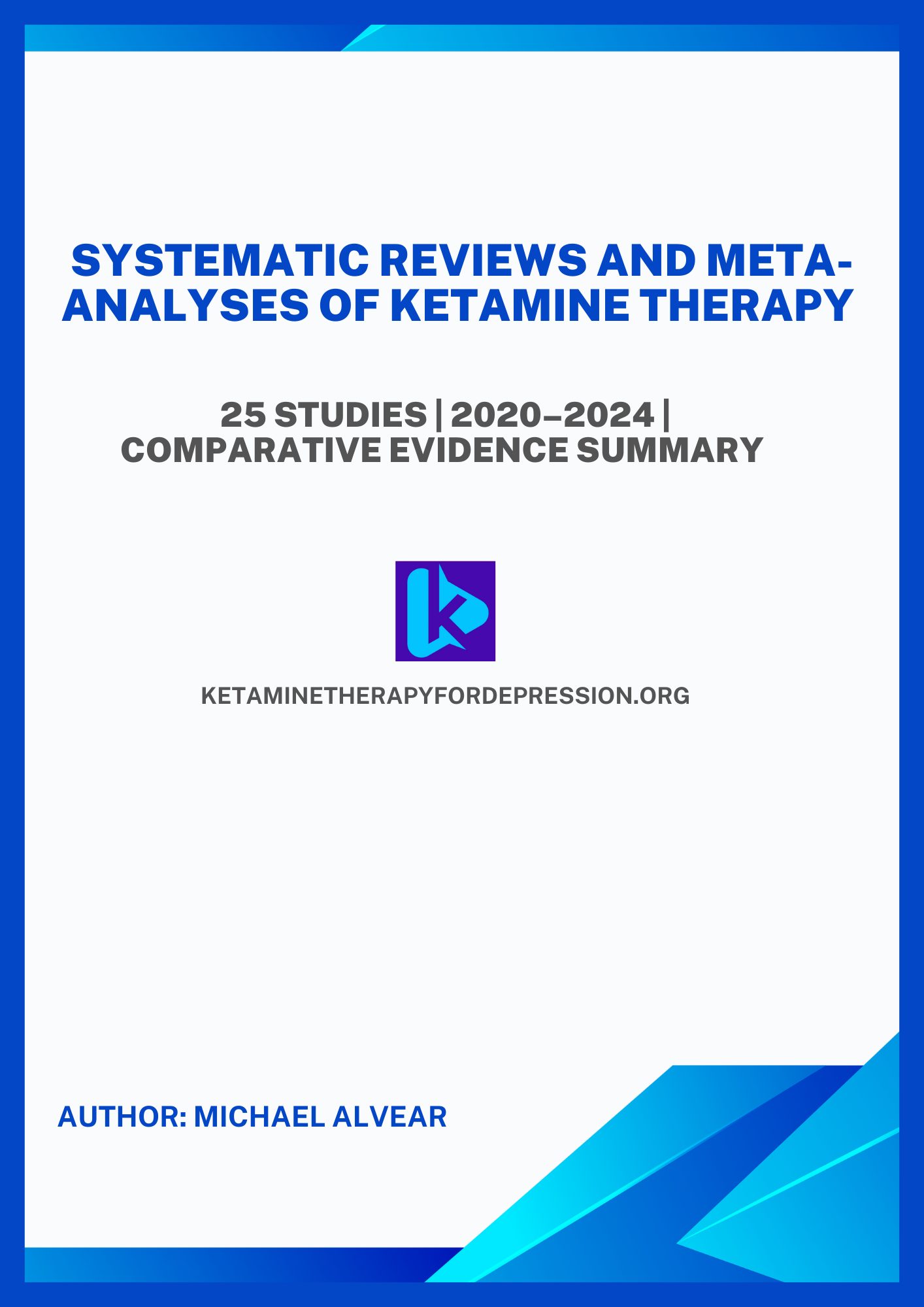
I pulled together 33 systematic reviews from the last five years into one report—so you don’t have to rely on hype, guesses, or anecdotes. This is the highest level of real-world evidence we have.
Inside My Report You’ll Find
- What percent of patients enter remission—broken down by delivery method
- Which method is most effective—IV, injection, or Spravato nasal spray
- How fast ketamine can work to reduce or end symptoms
- Which combinations (like psychotherapy) may enhance response
- And a lot more…
Verified by the Platforms That Matter
This research summary report has been published across four trusted platforms that host peer-reviewed or open science content, including:
– Published ketamine research on Zenodo
– Ketamine evidence summary hosted on SSRN
– Scientific report on ketamine outcomes on Figshare
– Evidence-based ketamine therapy report on OSF