
How Much Does Spravato, IV, Injection and Oral Ketamine Cost in Atlanta?
| Treatment Option | Cost Per Treatment (Median) | # of Treatments | Total Cost (Median) | Notes |
|---|---|---|---|---|
| Spravato (No Insurance) | $1,050/session | 21 | $22,050 | Self-pay pricing varies by clinic. 21 sessions is the standard FDA protocol for the first 6 months. |
| Spravato (With Insurance Only) | $286/session | 21 | $6,000 | Based on typical insurance: $2,000 deductible, $6,000 out-of-pocket max, 20% coinsurance. Costs can shift dramatically based on your plan. 21 sessions is the standard FDA protocol for the first 6 months. |
| Spravato (Insurance + Manufacturer Subsidy) | $135/session | 21 | $2,835 | Assumes typical insurance plus manufacturer copay support for eligible patients. 21 sessions is the standard FDA protocol for the first 6 months. |
| IV Ketamine | $500/infusion | 15 | $7,500 | Number of infusions ranges from 11 to 18 depending on each individual—we chose 15 as a typical acute + early maintenance course based on common clinic protocols. |
| Injection (IM) Ketamine | $337/injection | 15 | $5,055 | Number of injections ranges from 11 to 18 depending on each individual—we chose 15 as a typical acute + early maintenance course based on common clinic protocols. |
| Oral/Sublingual Ketamine – Prescription from psychiatrist/physician | ~$75–$200 per fill (≈1 month) | No standard course | Open-ended* | Public schedules show compounding pharmacy per-unit pricing with a $50 minimum and common strengths of 100–200 mg per troche. A fill usually covers about a month of doses, but there is no agreed-upon number of months, so total cost depends entirely on how long you and your prescriber continue. Warning! The FDA warns against using compounded ketamine outside supervised settings. |
| Oral/Sublingual – Daily Micro-Dosing (Telehealth services like Joyous) | ~$129/month subscription | No standard course | Open-ended* | Low daily doses (≈10–20 mg/day) shipped as a bundle with app/check-ins; commonly advertised at ~$129/month. Studies of oral ketamine use short windows (4–6 weeks), but micro-dose programs explicitly say there is no set timeline and many patients stay on for months or years, so there is no honest “total” cost. Warning! The FDA warns against using compounded ketamine outside supervised settings. |
| Oral/Sublingual – Session-Based (At-Home Telehealth services like Mindbloom) | ~$90–$200 per at-home session | Blocks of 4–8+ sessions | Open-ended* | Telehealth brands sell finite blocks (e.g., 4 Wondermed doses, 6 Mindbloom sessions, 8 Innerwell sessions) at roughly $90–$200 per session, then encourage ongoing “healing journeys” or additional packages. There is no consensus on how many at-home oral ketamine sessions count as induction, maintenance, or extended maintenance, and no trial data on multi-year courses, so real-world total cost is structurally open-ended. Warning! The FDA warns against using compounded ketamine outside supervised settings. |
Notes on our Atlanta Ketamine Therapy Costs
How We Calculate Atlanta Ketamine Medians
Because ketamine prices are all over the map in Atlanta, we don’t throw a giant range at you — we show the median. That median comes from pricing we collected across a couple dozen ketamine clinics in the Atlanta metro area (north-central Georgia), so it reflects what a typical patient here actually pays, not an outlier in Buckhead or a bargain clinic far out in the suburbs. In a market this uneven, the median is the only number that stays honest: half of Atlanta clinics charge more, and half charge less.
Why Spravato Costs Aren’t Atlanta-Specific
Spravato is different. There’s basically no meaningful “Atlanta price” for Spravato unless you’re paying entirely out-of-pocket — and that almost never happens. For eligible patients, Spravato is overwhelmingly covered by commercial insurance, and once insurance is involved your cost is driven by your plan’s deductible, coinsurance, out-of-pocket max, and how the clinic bills the visit — not by what city you live in. So for Spravato, “local pricing” mostly means your insurance pathway, not an Atlanta-specific sticker price.
Table Notes on Oral & Sublingual
There are no FDA-approved schedules or professional guidelines that define how many doses or sessions a “full course” should include. Published trials use short, fixed windows, while real-world programs often run as subscriptions or repeating blocks with no clear stopping rule. Long-term total cost (and long-term safety) depends entirely on how long you and your prescriber decide to continue.
Table Notes on IV, Injection & Spravato
There is no “Atlanta price” for Spravato unless you pay for it out-of-pocket (rarely done). Spravato is almost universally covered by commercial health insurers so the numbers you see are based on the largest 18 health insurers (Cigna, UnitedHealthcare, etc.)
By Michael Alvear, Health Author & Independent Researcher
My research is published on these scholarly platforms:

Last Updated:
Let Me Walk You Through Everything I’ve Put Together on This Page
- Cost Per Ketamine Session in Atlanta (Infusion, Injection, Oral/Sublingual, Spravato)
- Estimated Number of Ketamine Sessions You’ll Need
- What You’ll Pay in Total (Price Per Session × Number of Sessions)
- Does Insurance Cover Ketamine Therapy?
- What You’ll Pay Out of Pocket for Spravato If Your Insurance Covers It
- Ketamine Clinics In Atlanta By Neighborhood
- How Atlanta’s Clinic Locations Affect Your Ketamine Treatment Options
FAQs on The Cost of Ketamine Therapy In Atlanta

Can’t Decide Between IV, Injections, Or Spravato?
Use My Decision Table
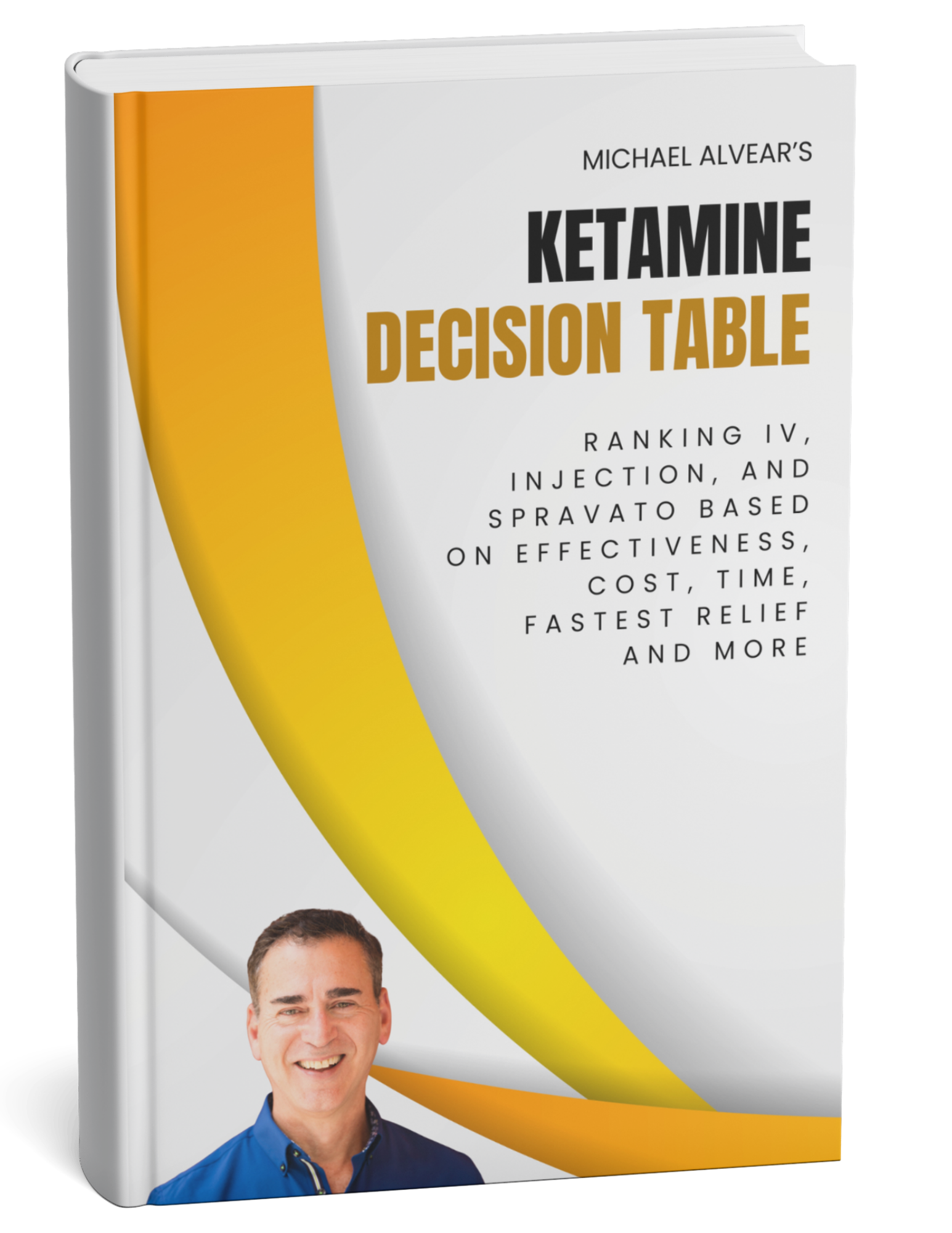
This report ranks all three options—IV, injection, and Spravato—on effectiveness, cost, fastest relief, and more, giving you a clear framework to decide.
Downloads as PDF • 5 minute read
Cost Per Ketamine Session in Atlanta (Infusion, Injection, Oral/Sublingual, Spravato)
QUICK ATLANTA SNAPSHOT (Per Treatment Unless Noted)):
• IV ketamine: $400–$600, median $500
• IM ketamine injections: $275–$400, median $337
• Spravato per treatment: $1,050 (self-pay), $120–$286/visit with insurance, $50–$135/visit with insurance + manufacturer subsidy
• Oral/sublingual, local prescription fill (about 1 month): $75–$200, median about $138 per fill
• Oral/sublingual micro-dosing telehealth: $129/month, median $129/month
• Oral/sublingual at-home session packages: $90–$200 per session, median about $145/session
| Treatment Type | Cost Per Treatment | Median Cost |
|---|---|---|
| IV Ketamine (No Insurance) | $400–$600 | $500 |
| Injection Ketamine (No Insurance) | $275–$400 | $337 |
| Spravato (Self-Pay, No Insurance) | $800–$1,300 | $1,050 |
| Spravato (With Commercial Insurance) | $140–$450 | $295 |
| Spravato (With Insurance + Manufacturer Subsidy) | $0–$62 | $31 |
| Oral/Sublingual Ketamine – Prescription from psychiatrist/physician | ~$75–$200 per fill (about 1 month) | ~$138 per fill |
| Oral/Sublingual – Daily Micro-Dosing (Telehealth services like Joyous) | ~$129/month subscription | $129/month |
| Oral/Sublingual – Session-Based (At-Home Telehealth services like Mindbloom) | ~$90–$200 per at-home session | ~$145/session |
How We Calculated These Ketamine Therapy Prices
Since most ketamine clinics won’t provide prices online or over the phone (see why below), we’ve compiled pricing from our analysis of 30 metropolitan markets nationwide, local provider research, and real patient billing data. The ranges you’ll see reflect what patients in the Atlanta area actually pay across different insurance scenarios, treatment methods, and clinic types.
This gives you realistic cost expectations before you walk into any local ketamine consultation—so you can plan your budget and ask informed questions about your specific situation.
Why It’s So Hard To Get Ketamine Costs In Atlanta
If you’ve tried calling ketamine clinics in say, Sandy Springs or Marietta asking “How much does treatment cost?” you’ve probably been told: “We need to see you for a consultation first.” This isn’t because they’re trying to hide anything—there are legitimate reasons not to quote you prices without first assessing your needs.
-
- Your Treatment Type Might Change After Assessment
You might call asking about oral ketamine, but after evaluation, the clinic may recommend IV infusions, injections, or Spravato instead — each with very different costs. - Your Total Cost Depends on How Many Sessions You’ll Need
Clinics can’t predict if you’ll need just a few sessions or a full multi-week protocol without first reviewing your medical history, diagnosis, and how you respond to early treatments. - Insurance Coverage Varies Wildly by Case
If you have commercial insurance, clinics often need to check your specific plan, prior authorizations, and any manufacturer subsidies before they can estimate what you’ll actually pay out of pocket. - You May Not Qualify for Certain Treatments
Not everyone qualifies for every ketamine option — for example, Spravato requires a specific FDA-approved diagnosis and documented antidepressant failures. Clinics can’t quote prices if they aren’t sure you’re eligible. - Doses and Protocols Are Personalized
Ketamine dosing isn’t one-size-fits-all. A patient with severe, long-term depression may need higher doses or longer infusions than someone with mild symptoms — and that directly affects cost. - Clinics Want to Build a Treatment Plan, Not Just Sell a Session
From the clinic’s perspective, they aren’t just selling “one ketamine session” — they’re designing a safe, effective treatment journey. That takes consultation time before they can talk realistic pricing. - What Billing Model Insurers Use Impacts Your Out-of-Pocket Costs
Some insurers in the metro area use “specialty pharmacy” billing (two separate charges), while others use “buy and bill” (one combined charge). The same Spravato session might cost you $180 or $420 depending on which model your insurer requires — something the clinic only discovers when they contact your insurance directly.
- Your Treatment Type Might Change After Assessment

Estimated Number of Ketamine Sessions You’ll Need
Unlike a typical medical procedure that happens once, ketamine therapy works through a series of carefully spaced sessions over several months. Think of it like physical therapy for severe depression—you need multiple visits to build and maintain the therapeutic effect.
Both IV ketamine and Spravato follow protocols designed to maximize your chances of remission:
| Treatment | Sessions in First 6 Months | Month 1 | Month 2 | Months 3-6 |
|---|---|---|---|---|
| IV & Injection Ketamine | 11–13 (low end) 14–18 (high end) |
6-8 (2-3x/week) |
~4 (weekly) |
4-6 (every 2-4 weeks) |
| Spravato | 21 | 8 (2x/week) |
4 (weekly) |
9 (biweekly) |
Why Oral and Sublingual Ketamine Aren’t on This Table
You may be wondering why oral and sublingual ketamine aren’t shown here.
The issue is that there’s no standardized, widely accepted schedule for what counts as a full oral/sublingual course. Clinical studies usually run short, fixed protocols (a small number of doses over a few weeks), while many real-world prescribers and telehealth programs operate more like ongoing treatment plans or subscriptions, with dose counts and timelines that vary a lot and often don’t have a clear stopping point.
The Per-Session Price Trap
When you see “$500 per IV ketamine session,” your brain anchors on that number. You might think, “I can afford $500 for treatment.” But as the table shows, you’re actually looking at 11-18 sessions for IV ketamine or exactly 21 sessions for Spravato over six months.
That $500 session becomes $5,500 for 11 treatments, or $9,000 for 18 sessions. Suddenly, what seemed like a manageable $500 expense transforms into a multi-thousand-dollar financial commitment that many Atlanta patients aren’t prepared for.
The Real Cost Reality Check
Consider two Atlanta patients: Sarah needs 11 IV sessions at $500 each (total: $5,500), while Mike requires 18 sessions (total: $9,000). Both were quoted the same “$500 per session” rate, but their actual treatment investments differ by $3,500.
This is why per-session pricing alone is misleading. The total protocol cost—what you’ll actually spend over six months—is the number that matters for your budget, insurance planning, and treatment decisions.
Important Note: These are average session counts based on clinical research and provider protocols. Your individual treatment may require significantly fewer or more sessions depending on your unique response to ketamine therapy. Click here to better understand why session counts vary so dramatically between IV ketamine, injections, and nasal spray—and what factors impact the exact number you need.
Takeaway
Looking only at per-session prices hides the real cost—because full ketamine treatment typically requires 11–18 IV sessions or 21 Spravato sessions over six months.

Total Ketamine Therapy Cost in Atlanta (Price × Number of Sessions)
| Treatment Type | Cost Per Treatment | Number of Treatments | Total Cost Range | Median Total Cost |
|---|---|---|---|---|
| IV Ketamine (100% Self-Pay–Insurance Won’t Cover It) |
$400-$600 | 11–18 | $4,400–$10,800 | $7,600 |
| Injection Ketamine (100% Self-Pay–Insurance Won’t Cover It) |
$275–$400 | 11–18 | $3,025–$4,400 | $3,712 |
| Spravato Nasal Spray (100% Self-Pay, If You Have No Insurance) |
$800–$1,300 | 21 | $16,800–$27,300 | $22,050 |
| Spravato Nasal Spray (With Commercial Insurance) |
$140–$450 | 21 | $2,940–$9,450 | $6,195 |
| Spravato Nasal Spray (With Insurance + Manufacturer Subsidy) |
$0–$62 | 21 | $0–$1,300 | $650 |
Why Oral and Sublingual Ketamine Are Broken Out Separately
You’ll notice oral and sublingual ketamine aren’t sitting in this total-cost table with IV, IM injections, and Spravato, even though we can estimate what a typical month of troches or a telehealth session costs.
That’s because total cost depends on treatment length — and for oral/sublingual ketamine, there isn’t a reliable “standard course.” Studies usually test short runs with a fixed number of doses. In the real world, though, many prescribers and telehealth services use flexible, ongoing dosing that can continue for months or longer, with no agreed stopping rule and big variation from patient to patient.
So a six-month “total” would look precise but wouldn’t be honest. Instead of forcing a fake number into this chart, we cover oral and sublingual ketamine in its own section, where we can explain why dosing schedules — and therefore long-term costs — are inherently variable.
Takeaway
In Atlanta, total six-month costs range from $4,400–$10,800 for IV, $3,025–$4,400 for injections, $2,940–$9,450 for insured Spravato, and $0–$1,300 with subsidies, while uninsured Spravato can exceed $27,000.
Does Insurance Cover Ketamine Therapy?
Insurance Only Covers The Spravato Nasal Spray
Insurance won’t touch IV infusions or intramuscular shots —even though these forms have been studied for over 20 years and deliver remission rates up to 72% when combined with therapy. Spravato? It maxes out around 49%.
Let that sink in. The treatment that’s faster, more adaptable, and shown in 33 systematic reviews to work better isn’t the one insurance pays for.
The FDA Stamp Explains Everything—But Creates A Huge Irony
Spravato is the only version of ketamine officially approved for depression by the FDA. That single approval opens the floodgates for insurance reimbursement. IV ketamine, on the other hand, is considered “off-label,” even though the underlying medication is the same—and even though it’s backed by decades of research.
Here’s where it gets frustrating: Mayo Clinic research shows that 21% of all prescriptions covered by insurance are for off-label use. We’re talking cancer drugs, heart medications, epilepsy treatments—the off-label pipeline is everywhere.
But when it comes to ketamine? Insurers slam the door shut.
It’s like standing in a pharmacy looking at two medicines—one generic, one name-brand—and being told your insurance will only cover the more expensive one, even though the cheaper one works better.
What You’ll Pay Out of Pocket for Spravato If Your Insurance Covers It
| Treatment Type | Cost Per Treatment | Number of Treatments | Total Cost Range | Median Total Cost |
|---|---|---|---|---|
| Spravato Nasal Spray (With Commercial Insurance) |
$140–$450 | 21 | $2,940–$9,450 | $6,195 |
Understanding the Median Out-of-Pocket Cost for Spravato
When you spread out costs across the full 21-session course, the average settles around $250 per treatment.
But averages can be misleading. That doesn’t mean each session rings up at $250. Upfront sessions, before your deductible is met, might cost $1,800 or more. If you’re on a high-deductible plan, your first month alone could total $5,000 or beyond. Once your deductible and out-of-pocket cap are hit, though, later sessions can drop dramatically—sometimes down to $30 or even zero.
That’s why $250 is best seen as a blended average over the whole course—not a guaranteed per-session price.
Individual costs vary because they depend on factors like:
- How large your deductible is and how much you’ve already paid toward it
- Whether your insurance applies a flat copay or percentage-based coinsurance
- Whether the clinic is billed as a hospital or outpatient provider
- How soon you reach your plan’s out-of-pocket maximum
This explains why patient stories vary so much—one person may call it affordable, while another describes a financial burden. Both experiences are valid.
Spravato Insurance Cost Calculator: Get Your Real Price
The single best way to know what Spravato will cost you is to run your exact insurance details through the calculator below. National medians are useful for a ballpark, but your real out-of-pocket comes down to where you are right now in your plan year.
This calculator doesn’t just ask what your deductible is. It also asks how much of that deductible you’ve already met, the same for your out-of-pocket maximum, and whether your plan uses a flat copay or a percentage coinsurance. Those four pieces are what cause one person’s first month to be a few hundred dollars and another person’s to be several thousand.
Put in your plan numbers and current progress, and you’ll see a personalized estimate for your early sessions, your later sessions, and the full 21-treatment course.
Spravato Insurance Cost Calculator
* Spravato is FDA-approved as a 21-session treatment (+ maintenance as needed). We’ll show your estimated total for all 21 sessions and the average cost per session.
Why your Spravato price in Atlanta won’t match anyone else’s
If you just used the calculator, you saw the core truth about Spravato costs: once insurance is involved, there is no real “Atlanta price.” Your out-of-pocket is mostly a function of your plan rules and where you are in your plan year, not your zip code.
The examples below show the main billing pathways that make costs swing so hard. They are here for two reasons: to help you interpret your calculator result, and to give you a clear fallback if you don’t know your plan details yet. You’ll see how the same Spravato course can land anywhere from high early-session bills to much lower later-session costs depending on deductibles, coinsurance, out-of-pocket caps, and how the clinic codes the visit.
Read these scenarios as the “why” behind your number.
How to Drop Spravato Costs to Near Zero With the Manufacturer Subsidy
If you qualify for Spravato’s assistance program, your out-of-pocket costs can drop dramatically. The manufacturer, Janssen, offers up to $8,150 in savings for eligible patients with commercial insurance. That can bring your per-session cost down to almost nothing—sometimes as low as $0, with a cap of $62 per visit.
Here’s what that looks like across a full course of treatment:
| Treatment Type | Cost Per Treatment | Number of Treatments | Total Cost Range | Median Total Cost |
|---|---|---|---|---|
| Spravato Nasal Spray (With Commercial Insurance) | $140–$450 | 21 | $2,940–$9,450 | $6,195 |
| Spravato Nasal Spray (With Insurance + Copay Card) | $0–$62 | 21 | $0–$1,300 | $650 |
In this best-case scenario, Spravato becomes by far the most affordable option—if you qualify. But that’s a big “if.” To qualify for the subsidy, you must:
- Have commercial (non-government) insurance
- Not be using Medicare, Medicaid, or VA coverage
- Be approved for Spravato through your insurer’s prior authorization process
For patients who need Spravato and have insurance, it’s worth applying. You can find the program details here.
Takeaway
For eligible patients, the Spravato subsidy cuts total six-month costs from up to $9,450 down to as little as $0–$1,300 depending on where you are in your insurance plan’s deductible and out-of-pocket max.
How Can You Be Sure Ketamine Therapy Actually Works?
I pulled together 33 systematic reviews from the last five years into one report—so you don’t have to rely on hype, guesses, or anecdotes. This is the highest level of real-world evidence we have.
Inside My Report You’ll Find
- What percent of patients enter remission—broken down by delivery method
- Which method is most effective—IV, injection, or Spravato nasal spray
- How fast ketamine can work to reduce or end symptoms
- Which combinations (like psychotherapy) may enhance response
- And a lot more…
Verified by the Platforms That Matter
This research summary report has been published across four trusted platforms that host peer-reviewed or open science content, including:
– Published ketamine research on Zenodo
– Ketamine evidence summary hosted on SSRN
– Scientific report on ketamine outcomes on Figshare
– Evidence-based ketamine therapy report on OSF
View the PDF Report Here:
Ketamine Clinics In Atlanta By Neighborhood
This table shows every ketamine clinic we identified in metro Atlanta, organized by location. Copy and paste this into a spreadsheet to sort by your preferred criteria.
| Clinic Name | Neighborhood/City | County | Phone Number |
|---|---|---|---|
| Atlanta Center for Ketamine Therapy | Smyrna | Cobb County | (678) 701-7725 |
| Atlanta Integrative Psychiatry | Buckhead | Fulton County | (404) 994-8282 |
| Atlanta Ketamine Center | Sandy Springs | Fulton County | (404) 709-2103 |
| Atlanta Ketamine Center | Sandy Springs | Fulton County | 404-709-2103 |
| Atlanta Pain Specialist | Alpharetta | Fulton County | 470) 299-1998 |
| Balanced Bodies Wellness Clinic | Decatur | DeKalb County | (404) 300-3491 |
| Breakthru Psychiatric Solutions | Sandy Springs | Fulton County | (470) 231-2235 |
| Breakthru Psychiatric Solutions | Alpharetta | Fulton County | 678-919-2612 |
| Complete Ketamine Solutions of Atlanta | Smyrna | Cobb County | (678) 247-1131 |
| Divine Wellness Clinic | Lawrenceville | Gwinnett County | 678-404-5352 |
| Dr. Sambunaris & Associates | Alpharetta | Fulton County | (770) 817-9200 |
| Emory Wesley Woods Hospital | North Druid Hills | DeKalb County | 404-728-6222 |
| Invictus Clinic | Marietta | Cobb County | (770) 580-0979 |
| Luna Mindful Infusions | Roswell | Fulton County | (770) 824-4712 |
| Metro Atlanta Psychiatry | Smyrna | Cobb County | (404) 456-6482 |
| North Atlanta Attento Ketamine Center | Marietta | Cobb County | (678) 216-8167 |
| Psych Atlanta | Marietta | Cobb County | 770-422-2009 |
| Psych Atlanta | Roswell | Fulton County | 770-667-1264 |
| Psych Atlanta | Johns Creek | Fulton County | 470-737-1569 |
| Revive Ketamine Centers | Buford | Gwinnett County | (470) 389-5400 |
| Taylor Medical Wellness Group | Sandy Springs | Fulton County | 678-443-4000 |
Quick takeaways from this list:
- Sandy Springs is ketamine central with 4 clinics (including 2 Atlanta Ketamine Center locations)
- Three clinic chains are expanding: Psych Atlanta (3 locations), Atlanta Ketamine Center (2 locations), and Breakthru Psychiatric Solutions (2 locations)
- Hospital option available: Emory Wesley Woods offers ketamine therapy in a traditional hospital setting
How Atlanta’s Clinic Locations Affect Your Ketamine Treatment Options
The good news? Atlanta has a growing ketamine therapy market. The frustrating news? Where you live in metro Atlanta dramatically affects your access to treatment.
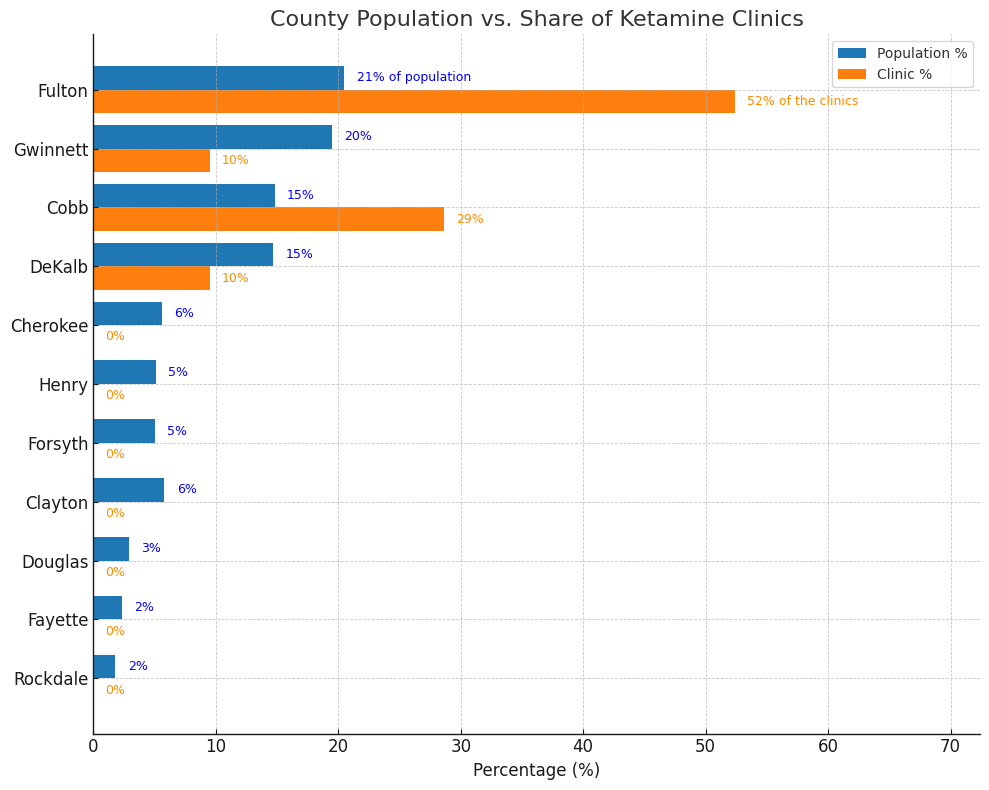
Here’s the reality: 21 ketamine clinics serve the 5.2 million people in metro Atlanta, generating an estimated $100-140 million annually in revenue. But these clinics aren’t spread evenly across the region—they’re heavily concentrated in affluent northern suburbs, leaving entire counties without a single option.
The bottom line for patients: If you live in Fulton or Cobb counties, you have multiple nearby options. If you live in Cherokee, Henry, Forsyth, Clayton, Douglas, Fayette, or Rockdale counties, you’ll need to drive 30+ minutes to reach any ketamine clinic. This geographic reality directly impacts both your travel costs and treatment accessibility.
The Stark Geographic Reality: Where Clinics Are (And Aren’t)
Here’s the table that tells the whole story about ketamine access in metro Atlanta. We’ve included ALL 11 counties in the Atlanta Regional Commission, so you can see exactly how many options exist in your area:
| County | 2024 Population | % of Metro | Clinic Count | % of Clinics | Clinics per 100K |
|---|---|---|---|---|---|
| Fulton | 1,068,000 | 20.5% | 11 | 52.4% | 10.3 |
| Gwinnett | 1,012,112 | 19.5% | 2 | 9.5% | 2.0 |
| Cobb | 767,000 | 14.8% | 6 | 28.6% | 7.8 |
| DeKalb | 764,000 | 14.7% | 2 | 9.5% | 2.6 |
| Cherokee | 290,000 | 5.6% | 0 | 0% | 0 |
| Henry | 265,000 | 5.1% | 0 | 0% | 0 |
| Forsyth | 260,000 | 5.0% | 0 | 0% | 0 |
| Clayton | 300,000 | 5.8% | 0 | 0% | 0 |
| Douglas | 153,000 | 2.9% | 0 | 0% | 0 |
| Fayette | 120,000 | 2.3% | 0 | 0% | 0 |
| Rockdale | 95,000 | 1.8% | 0 | 0% | 0 |
| Total Metro | 5,200,000 | 100% | 21 | 100% | 4.0 |
What This Means for You
If you live in the “big four” counties (Fulton, Cobb, Gwinnett, DeKalb), you have options—though some are much better than others. Fulton County residents have 11 clinics to choose from, while Gwinnett County residents (despite having over 1 million people) have only 2.
If you live in any of the seven counties with zeros, you’re looking at a road trip for treatment. That’s 1.28 million people—25% of metro Atlanta—living in counties without a single ketamine clinic.
Think of it this way: if ketamine clinics were grocery stores, seven entire counties would be “food deserts.” You’d have to drive to another county just to get basic access to treatment.
How We Gathered This Information
Our methodology: We compiled this list through systematic research of ketamine clinics serving the Atlanta metro area, then verified locations and mapped them to counties using official Atlanta Regional Commission boundaries.
Population data source: Atlanta Regional Commission 2024 Population Estimates
Important note: This represents ketamine clinics we could identify through public research. Some smaller practices or newly opened clinics might not be included. If you know of a clinic we missed, the pattern of geographic concentration would likely remain the same.
What’s next: In the following sections, we’ll explore how the cost of ketamine therapy aligns with the income levels of different areas, estimate the total market size, and identify which areas might see new clinics opening soon.
City-Level Reality: The Northern Suburbs Dominate
Now that you know which counties have clinics, let’s get more specific. If you’re trying to figure out which clinic might be closest to you, or whether it’s worth moving to be closer to treatment options, this city-by-city breakdown tells the real story.
Where the Clinics Actually Are
| City | Number of Clinics | County | What This Means |
|---|---|---|---|
| Sandy Springs | 4 | Fulton | The ketamine capital of Atlanta |
| Smyrna | 3 | Cobb | Multiple options in Cobb County |
| Alpharetta | 3 | Fulton | North Fulton hub |
| Marietta | 3 | Cobb | Another Cobb County cluster |
| Roswell | 2 | Fulton | Decent options |
| Buckhead | 1 | Fulton | Single option in affluent area |
| Decatur | 1 | DeKalb | Only option in central DeKalb |
| Lawrenceville | 1 | Gwinnett | Serving 1M+ county residents |
| North Druid Hills | 1 | DeKalb | Hospital-based option |
| Johns Creek | 1 | Fulton | Wealthy suburb coverage |
| Buford | 1 | Gwinnett | Far northeast option |
The Geographic Clustering Pattern
Looking at this city breakdown, a clear pattern emerges that affects both your travel time and treatment costs:
The “Golden Triangle” of Ketamine Therapy
The highest concentration of clinics forms a triangle in the northern suburbs: Sandy Springs (4 clinics) → Alpharetta (3 clinics) → Marietta (3 clinics). If you live within this triangle, you’re in ketamine therapy heaven—multiple options, competitive pricing, and short drive times.
The “Drive Zone” Areas
Cities like Roswell, Buckhead, and Johns Creek have decent access but fewer choices. You’ll likely have 1-2 realistic options within a 15-minute drive.
️ The “Road Trip” Reality
If you live in Gwinnett County (except near Buford or Lawrenceville), you’re looking at a 30-45 minute drive to reach most clinics. Same goes for residents of DeKalb County who don’t live near Decatur or North Druid Hills.
What the Clustering Means for Costs
Sandy Springs saturation: With 4 clinics packed into one area, including 2 Atlanta Ketamine Center locations, pricing could go either direction. All that competition might drive costs down as clinics fight for patients, or it could signal a premium market where everyone charges top dollar because the clientele can afford it.
Lawrenceville’s lone wolf: Serving 1M+ Gwinnett residents with just one clinic creates an interesting dynamic. That clinic might charge premium prices because they don’t face local competition, or they might keep costs reasonable to serve the broader community. Without local competition, it’s really anyone’s guess which direction they’ve chosen.
Travel costs add up: Remember to factor in gas, time off work, and potentially paying for parking when calculating your total treatment cost. If you’re driving from, say, Douglasville to Sandy Springs, that’s an hour each way plus gas—easily adding $30-50 per session to your total cost.
Over-Served vs. Under-Served Areas
✅ Over-Served Areas (Lucky You!)
- Sandy Springs vicinity: 4 clinics in one city is almost absurd. Residents here have the luxury of choice.
- North Fulton corridor: Alpharetta, Roswell, Johns Creek residents can easily access multiple options.
- Cobb County triangle: Smyrna, Marietta, and nearby areas have good coverage.
⚠️ Under-Served Areas (Plan for Longer Drives)
- Eastern Gwinnett: Over 500,000 people with essentially 1 clinic (Buford) serving them.
- Southern DeKalb: Residents often drive 45+ minutes to reach treatment.
- All of south metro: Henry, Clayton, Fayette counties = zero local options.
- Western suburbs: Douglas County and western Cobb areas face long drives.
❌ Completely Unserved Areas (Serious Travel Required)
- Cherokee County: 290,000 people, zero clinics. Nearest options in Marietta or Alpharetta.
- Forsyth County: 260,000 people relying on options in Alpharetta or Roswell.
- South metro counties: Henry, Clayton residents looking at 45-60 minute drives minimum.
Takeaway
Atlanta’s 21 ketamine clinics are packed into the affluent northern suburbs, meaning patients in Cherokee, Forsyth, Henry, and Clayton often face 30–60 minute drives just to access basic treatment.
The “Clinic Chain” Advantage
Three clinic chains operate multiple locations, which can benefit patients:
- Psych Atlanta (3 locations): Marietta, Roswell, Johns Creek—gives you flexibility if one location is booked
- Atlanta Ketamine Center (2 locations): Both in Sandy Springs—suggests they’re doing well enough to expand locally
- Breakthru Psychiatric Solutions (2 locations): Sandy Springs and Alpharetta—covers the north Fulton corridor
Patient benefit: If you start treatment at one location in a chain and move, or if your preferred location is booked, you can potentially continue treatment at their other location with the same protocols and records.
Why Ketamine Clinics Cluster in Wealthy Areas (And What That Means for You)
If you’ve been wondering why most ketamine clinics seem to be in the priciest parts of Atlanta, you’re not imagining things. There’s a clear economic pattern here that directly affects both where you can get treatment and how much you’ll pay for it.
The Income Reality: Clinics Follow the Money
We mapped every clinic location to income data, and the results are striking. Here’s where Atlanta’s ketamine clinics have chosen to set up shop:
| City/Area | Clinic Count | Income Level | Median Household Income | vs. National Average |
|---|---|---|---|---|
| Sandy Springs | 4 | Highest-Income | $173,761 | 2.3x higher |
| Alpharetta | 3 | High-Income | $128,578 | 71% higher |
| Roswell | 2 | High-Income | $124,329 | 65% higher |
| Marietta | 3 | High-Income | $120,851 | 61% higher |
| Buckhead | 1 | Highest-Income | $173,761 | 2.3x higher |
| Johns Creek | 1 | High-Income | $113,422 | 51% higher |
| Smyrna | 3 | Middle-Upper | ~$80,000* | 7% higher |
| North Druid Hills | 1 | Middle-Upper | ~$75,000* | Similar |
| Decatur | 1 | Mixed Income | ~$65,000* | 13% lower |
| Lawrenceville | 1 | Mixed Income | ~$70,000* | 7% lower |
| Buford | 1 | Mixed Income | ~$75,000* | Similar |
*Estimated based on county and regional data where specific ZIP code data wasn’t available
National median household income: $75,149 | Source: Census data via Stacker
The Numbers Tell the Story
The Wealthy Area Concentration
14 out of 21 clinics (67%) are located in cities where the median household income is significantly above the national average. These areas have lots of people who can afford $400-600 per session without insurance coverage.
- Sandy Springs + Buckhead: Median income over $173K—more than double the national average
- Northern suburb cluster: Alpharetta, Roswell, Marietta all 50-70% above national average
- High earner concentration: 55-65% of households in these areas earn over $100K annually
️ The Middle-Income Presence
5 out of 21 clinics serve more economically diverse areas. These tend to be single clinics serving large populations:
- Smyrna (3 clinics): The exception—multiple clinics in a middle-income area
- Hospital option: Emory Wesley Woods in North Druid Hills may accept more insurance
- Gwinnett representation: Lawrenceville and Buford serve the massive, diverse Gwinnett population
Why This Income Pattern Exists
Follow the cash-pay customers: Since most insurance plans don’t cover IV or injection ketamine for depression, clinics need patients who can afford the high out-of-pocket costs. It makes sense to build clinics where lots of people make $100K+.
Real estate costs matter too: Clinics need nice, comfortable spaces for 2-3 hour treatment sessions. Rent in Sandy Springs or Alpharetta isn’t cheap, but these areas attract patients willing to pay premium prices.
Referral networks: Wealthy areas have lots of psychiatrists and mental health professionals who can refer patients to ketamine clinics. It’s an ecosystem that feeds itself.
What This Means for Your Treatment Costs
Expect Premium Pricing in Wealthy Areas
Clinics in Sandy Springs, Alpharetta, and Buckhead know their local market can afford higher prices. If you’re getting treatment in these areas, you’re probably paying top dollar—but you also have the most options to shop around.
Look for Value in Mixed-Income Areas
The clinics in Smyrna, Lawrenceville, and Buford might offer more competitive pricing since they serve more price-sensitive populations. It’s worth calling around—you might save $100-200 per session.
Consider the Hospital Option
Emory Wesley Woods Hospital in North Druid Hills might be more likely to work with insurance or offer payment plans compared to boutique clinics in wealthy areas. Hospital-based treatment often has different pricing structures.
The Access Barrier Reality
⚠️ The Unspoken Treatment Barrier
Let’s be honest about what this income concentration means: ketamine therapy in Atlanta is primarily accessible to upper-middle-class and wealthy patients. If you’re making $40K-60K per year, spending $3,000+ on a treatment series (plus travel costs) is financially devastating.
This creates a healthcare equity issue where an innovative, potentially life-saving treatment is geographically and economically segregated.
Strategies for Lower-Income Patients
If the income barrier feels overwhelming, here are some approaches to consider:
- Call clinics in mixed-income areas first: Smyrna, Lawrenceville, and Buford locations may be more flexible on pricing
- Ask about payment plans: Some clinics offer financing, especially if you’re upfront about budget constraints
- Research clinical trials: Emory and other Atlanta medical centers sometimes run ketamine studies with free treatment
- Consider the hospital option: Emory Wesley Woods might work with insurance or have sliding scale fees
- Factor in total costs: A clinic in Sandy Springs might charge more per session but save you gas money if you live nearby
The Bottom Line on Income and Access
The geographic concentration of ketamine clinics in wealthy areas isn’t an accident—it’s a business model based on cash-pay customers who can afford premium pricing. Understanding this helps you:
- Set realistic budget expectations based on your chosen clinic’s location
- Identify potentially lower-cost options in more economically diverse areas
- Understand why you might need to travel far if you live outside affluent areas
- Plan for the total cost including travel, parking, and time off work
The concentration in wealthy areas also suggests that as insurance coverage for ketamine therapy expands, we might see clinics opening in more economically diverse parts of metro Atlanta. But for now, your income level and location significantly impact both access and cost.
Takeaway
Whether paying $400–$600 per IV session or managing Spravato’s high insurance copays, Atlanta ketamine patients face costs that disproportionately limit access to upper-income households.
FAQs on The Cost of Ketamine Therapy In Atlanta
How Much Does An IV Ketamine Infusion Cost In Atlanta And Is It Covered By Insurance?
IV ketamine infusions cost $400-$600 per session in Atlanta, with a median price around $500. Insurance does not cover IV ketamine for depression treatment, making this a 100% out-of-pocket expense for patients.
Insurance companies only cover Spravato nasal spray because it has FDA approval specifically for depression. IV ketamine is considered “off-label” use despite decades of research showing effectiveness rates up to 72% when combined with therapy. That means even though IV ketamine often works better than the FDA-approved option, you’ll pay entirely out of pocket.
The lack of insurance coverage creates a significant financial barrier, as patients must budget for multiple sessions without any assistance from their health plans. This is particularly frustrating since 21% of all prescriptions covered by insurance are for off-label use in other medical areas.
How Much Does An Intramuscular Injection Of Ketamine Cost In Atlanta And Is It Covered By Insurance?
Intramuscular ketamine injections cost $275-$400 per session in Atlanta, with a median price around $337. Insurance does not cover ketamine injections for depression, making this entirely out-of-pocket.
Injections offer the same therapeutic benefits as IV infusions but cost about $150-200 less per session. The lower price point makes injections an attractive alternative for patients seeking ketamine therapy on a tighter budget. However, like all ketamine treatments except Spravato, insurance treats injections as off-label use with no coverage.
The cost difference stems from simpler administration requirements and shorter clinic visits compared to IV infusions. You’ll still receive the same medication and therapeutic effects, just through a different delivery method that requires less clinical infrastructure.
How Much Does A Single Treatment Of The Nasal Spray Spravato Cost In Atlanta And Is It Covered By Insurance?
A single Spravato treatment costs $800-$1,300 without insurance, but drops to $140-$450 per session with commercial insurance coverage. With insurance plus manufacturer subsidies, costs can fall to $0-$62 per treatment.
Insurance covers Spravato because it’s the only ketamine treatment with FDA approval specifically for depression. However, your actual out-of-pocket cost varies dramatically based on your deductible and plan details. Early treatments might cost over $1,800 before your deductible is met, while later sessions could cost almost nothing once you hit your out-of-pocket maximum.
Eligible patients can apply for Janssen’s manufacturer subsidy program, which provides up to $8,150 in assistance. This program requires commercial insurance (not Medicare, Medicaid, or VA coverage) and can reduce costs to nearly zero for qualifying patients.
How Many IV Ketamine Sessions Do I Need, And Over What Time Period?
Most patients need 11-18 IV ketamine sessions over six months following a structured treatment protocol. You’ll receive 6-8 sessions in the first month (2-3 times weekly), about 4 sessions in the second month (weekly), then 4-6 maintenance sessions every 2-4 weeks during months 3-6.
The initial intensive phase builds therapeutic effects rapidly, while maintenance sessions sustain improvements over time. Think of it like physical therapy for severe depression—multiple visits are needed to establish and maintain the therapeutic benefit. Some patients respond well with fewer sessions on the lower end of the range, while others with severe, treatment-resistant depression may need the full 18 sessions.
Clinical response typically occurs within the first 3 months for patients who will benefit from treatment. A clinical response means symptoms improve by about 50%, while remission means symptoms become minimal or disappear entirely. In practice, this usually looks like regaining interest in activities, improved sleep, and better emotional regulation.
How Many Intramuscular Injections Of Ketamine Do I Need, And Over What Time Period?
Intramuscular ketamine injections follow the same treatment schedule as IV infusions: 11-18 sessions over six months. You’ll start with 6-8 injections in the first month (2-3 times weekly), continue with about 4 weekly injections in month two, then receive 4-6 maintenance injections every 2-4 weeks for months 3-6.
The injection method delivers ketamine through muscle tissue rather than directly into the bloodstream, but the therapeutic protocol remains identical to IV treatment. Both approaches work by creating and maintaining ketamine’s rapid-acting antidepressant effects through carefully spaced sessions that allow your brain to build new neural pathways.
Most patients who benefit from ketamine injections experience symptom improvement within the first 3 months. You’ll typically notice changes in mood, energy levels, and thinking patterns during this initial period. Maintenance sessions prevent symptom return and help consolidate the therapeutic gains made during intensive treatment.
How Many Spravato Sessions Do I Need, And Over What Time Period?
Spravato follows a structured 21-session protocol over six months. You’ll receive 8 sessions in the first month (twice weekly), 4 sessions in the second month (weekly), then 9 sessions during months 3-6 (every two weeks).
Unlike IV ketamine and injections, which offer flexible scheduling based on individual response, Spravato uses a fixed protocol designed around clinical trial data. This standardized approach ensures consistent dosing and monitoring, as Spravato requires observation at the clinic for at least two hours after each treatment due to potential side effects like dizziness or dissociation.
Most patients who respond to Spravato show clinical improvement within the first 3 months, meaning symptoms decrease by roughly half. Remission—where symptoms become minimal or resolve completely—typically occurs during this same timeframe for patients who will achieve it. The structured schedule ensures you receive adequate exposure to determine effectiveness while maintaining safety protocols.
How Many Ketamine Clinics Are In Atlanta And Where Are They Located?
Atlanta has 21 ketamine clinics serving the metro area, but they’re heavily concentrated in affluent northern suburbs, leaving entire counties without local access. Sandy Springs leads with 4 clinics, followed by Smyrna, Alpharetta, and Marietta with 3 clinics each.
The clinics cluster primarily in Fulton County (11 clinics) and Cobb County (6 clinics), while Gwinnett and DeKalb counties have only 2 clinics each despite large populations. Seven counties—Cherokee, Forsyth, Henry, Clayton, Douglas, Fayette, and Rockdale—have zero ketamine clinics, forcing 1.28 million residents to drive 30-60 minutes for treatment.
Three clinic chains operate multiple locations: Psych Atlanta (Marietta, Roswell, Johns Creek), Atlanta Ketamine Center (2 Sandy Springs locations), and Breakthru Psychiatric Solutions (Sandy Springs, Alpharetta). This geographic concentration means your treatment options and costs depend heavily on where you live in metro Atlanta.
Clinical Evidence & Sources for This Page
These evidence summaries explain how much Spravato and other ketamine treatments can cost with and without insurance, from in-clinic IV infusions to at-home telehealth tablets. They link directly to economic evaluations, savings-program rules, and real-world pricing examples used to build the cost ranges and calculators on this page.
How much does Spravato cost without insurance? This NCBI health technology assessment reviews esketamine as a high-cost, in-clinic treatment and uses modeling to estimate drug and administration costs for patients and payers.
NCBI Bookshelf – Clinical and economic overview of esketamine
How much does Spravato cost without insurance? This PubMed-indexed analysis models the cost-effectiveness of adding esketamine to standard care, showing how drug price and clinic visits drive total treatment cost and value.
How much does Spravato cost without insurance? Harvard health economists at CHDS evaluate the cost-effectiveness of esketamine for treatment-resistant depression, comparing its high upfront price to expected gains in quality of life.
How much does Spravato cost with insurance? This study examines esketamine coverage policies, including prior authorization, patient cost-sharing, and how insurers’ decisions affect out-of-pocket costs.
How much does Spravato cost with insurance? Real-world claims data here describe approval rates, typical copays and deductibles, and the budget impact of covering Spravato for treatment-resistant depression.
How much does Spravato’s withMe Savings help? The official program requirements spell out eligibility rules, annual caps, and exclusions so you can estimate how much the copay card might reduce your Spravato bills.
How much does Spravato’s withMe Savings help? This Janssen withMe page walks patients through enrollment, verification of commercial insurance, and how savings are applied at the pharmacy or clinic.
How much does IV ketamine cost? Avest Ketamine & Wellness lists per-infusion prices for IV ketamine and nasal treatments, giving a concrete example of self-pay rates before insurance or discounts.
Avest Ketamine & Wellness – Example IV ketamine infusion pricing
How much does IV ketamine cost? NOMA Therapy’s cost overview breaks down typical price ranges for IV, nasal, and oral ketamine, plus factors like number of sessions and monitoring fees that shape the total bill.
How much does IV ketamine cost? Athena Care’s service page explains how ketamine for depression is delivered in-clinic, discusses insurance versus self-pay options, and outlines financial considerations for a full course of treatment.
Compounded pharmacy costs of oral/sublingual ketamine when a psychiatrist or physician writes the prescription. This review discusses compounded oral ketamine formulations, dosing, and pharmacy preparation, providing context for how medication and compounding practices contribute to overall cost.
Daily microdosing costs of oral/sublingual ketamine. Joyous publishes subscription-level pricing for low-dose daily ketamine, showing how at-home microdosing bundles medication, monitoring, and support into a monthly fee.
Macro dosing of oral/sublingual ketamine via telehealth. Smith Family MD outlines its at-home ketamine treatment protocol, including dose schedules, telehealth visit requirements, and example pricing so patients can anticipate program costs.
Smith Family MD – Telehealth macrodose ketamine protocol & pricing
Macro dosing of oral/sublingual ketamine via telehealth. Wondermed describes its comprehensive at-home ketamine program, detailing package pricing, what is included in the fee, and how costs compare to traditional in-clinic care.
Macro dosing of oral/sublingual ketamine via telehealth. NOMA Therapy explains how insurance may or may not cover at-home ketamine services and what patients can expect to pay out of pocket for macrodose programs.
Macro dosing of oral/sublingual ketamine via telehealth. Ketamine Central GA publishes detailed pricing for its ketamine treatments, offering another real-world benchmark for per-session and package costs.