• Skip to main content
  • Skip to after header navigation
  • Skip to site footer
  • HOME
  • Start here
  • About Michael Alvear
    • My Mission Statement
    • Contact Me
    • My Journey
    • Medical Disclaimer
    • Privacy Policy
    • Medical Review Standards: Expert Transparency & Editorial Process
  • Ketamine Therapy Basics
    • What Is it?
    • How Does It Work?
    • Side Effects
    • Are You a Candidate?
    • Which Type of Ketamine Treatment Should You Choose?
    • The Complete Guide To Oral Ketamine [2025]
    • IV Ketamine vs. Spravato: Which Is Better?
    • Inside Ketamine Clinics
    • Integration makes ketamine work
  • How to Get a Free Ride to Your Medical Appointments
  • Effectiveness & Comparisons
    • Up to 70% Remission Rates
    • Works Faster Than Other Treatments
    • How It’s Different Than Other Treatments
    • IV Ketamine vs. Nasal Spray
    • Ketamine vs. SSRIs: Which Works Best?
    • Research Resource Hub
  • Cost & Insurance
    • Does Insurance Cover Spravato?
    • How Much Does Spravato Cost With & Without Insurance? 2025 Cost Guide + Calculator
    • Guide to Costs & Insurance Coverage
    • Spravato Costs with Insurance
    • IV Ketamine vs. Spravato: How Many Sessions You’ll Need To End or Substantially Reduce Depression
    • How Much Does Ketamine Therapy Cost? What You’ll Pay for IV, Spravato, and Injections
    • Does Insurance Cover Ketamine Therapy
  • Celebrity Deaths & Misuse
    • Will Musk Do To Ketamine What He Did To Tesla?
    • Ketamine and Matthew Perry’s Death
    • First Matthew Perry, Now The Vivienne. The Ketamine Panic Is Here
  • Blog
  • Find Nearest Clinic
ketamine therapy for depression

Spravato vs IV Ketamine for Depression: Typical Number of Sessions and Timeline

Medical stethoscope

This page has been medically reviewed by a board-certified psychiatrist with clinical experience in mood disorders on November 13, 2025.

Michael Alvear

By Michael Alvear, Health Author & Independent Researcher

My research is published on these scholarly platforms:

Scholarly Platforms

Last Updated: November 13, 2025

Spravato follows a fixed 21-session plan over six months, while IV ketamine typically uses 11–18 sessions—about 14% to 48% fewer visits, depending on your response and schedule.

Ketamine Treatment Sessions Guide

Your Complete Treatment Sessions Guide

Understanding how many IV ketamine and Spravato treatments you’ll need

1
How Many IV Ketamine or Spravato Treatments You’ll Need in the First 6 Months
Complete overview of treatment timelines and session requirements

2 min read ›

2
Spravato’s Structured 21-Session Treatment Schedule
FDA-approved protocol with specific timing and frequency requirements

1 min read ›

3
IV Ketamine’s Flexible 11-18 Session Approach
Understanding the induction phase and maintenance protocols

1 min read ›

4
Why Does Spravato Require More Treatment Sessions Than IV Ketamine?
The pharmacology and clinical reasoning behind different protocols

6 min read ›

5
How Spravato’s More Sessions Impact Your Time, Logistics & Resources
Real-world considerations for planning your treatment journey

8 min read ›

6
Frequently Asked Questions
Quick answers about ketamine treatment session requirements

4 min read ››

Can’t Decide Between IV, Injections, Or Spravato?

Use My Decision Table
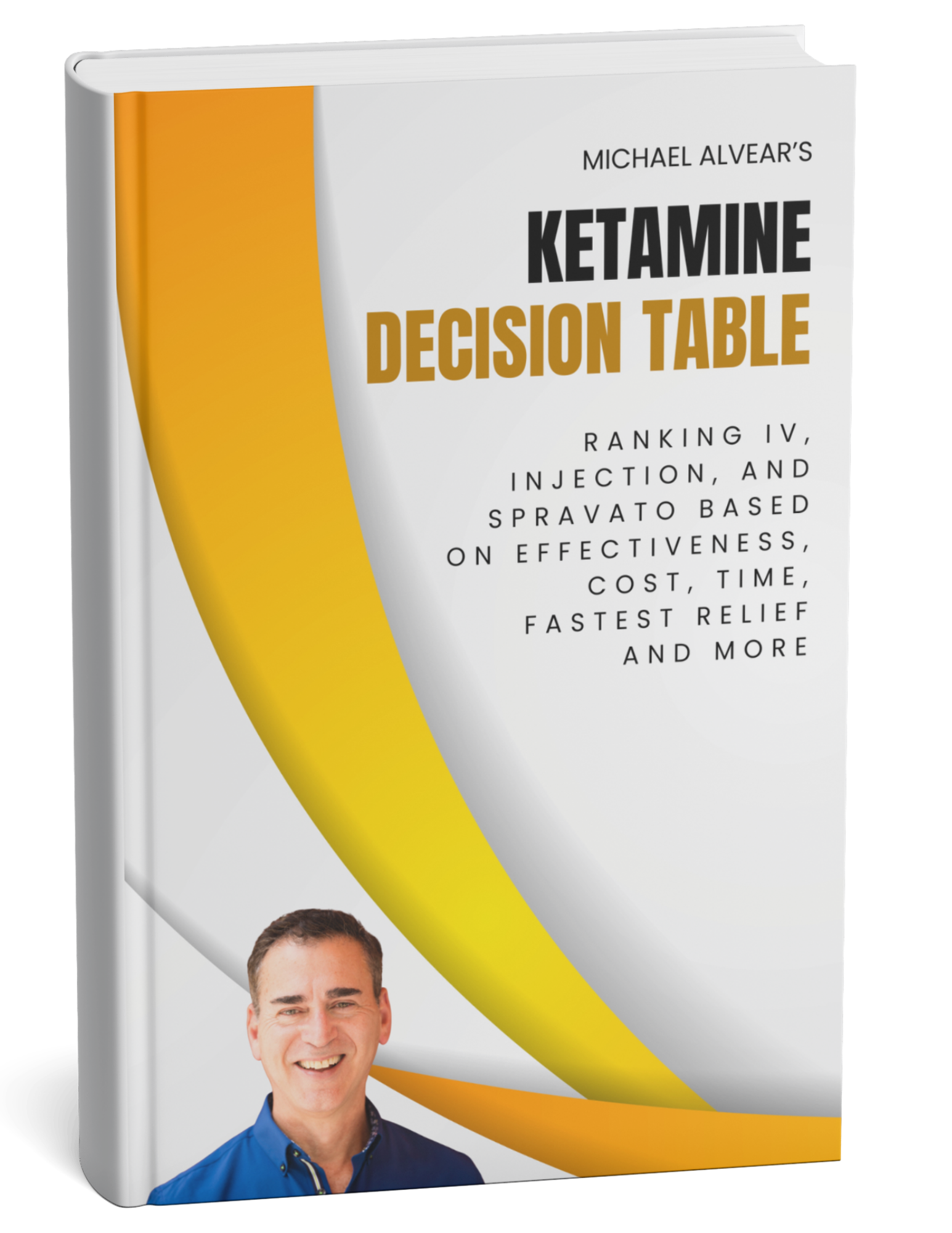
Ketamine Decision Table PDF

This report ranks all three options—IV, injection, and Spravato—on effectiveness, cost, fastest relief, and more, giving you a clear framework to decide.

Get My Decision Table

Downloads as PDF • 5 minute read

1

How Many IV Ketamine or Spravato Treatments You’ll Need in the First 6 Months

Spravato has a structured 21-session protocol over six months, while IV ketamine uses a flexible schedule of 11-18 sessions that can be adjusted based on your individual response to treatment.

Here’s a direct comparison of what to expect in the first six months—the timeframe when most patients either reach remission, achieve substantial symptom relief they find satisfactory, or discontinue treatment due to lack of response.

Treatment Sessions in First 6 Months Month 1 Month 2 Months 3-6
IV Ketamine 11–13 (low end)
14–18 (high end)
6-8
(2-3x/week)
~4
(weekly)
4-6
(every 2-4 weeks)
Spravato 21 8
(2x/week)
4
(weekly)
9
(biweekly)

Most patients receive 11-18 IV ketamine sessions over six months, while Spravato’s FDA-approved protocol involves 21 sessions during the same period. This isn’t just a number—it’s a significant difference in time commitment, work disruption, transportation needs, scheduling burden, cost, and overall treatment experience.

Ketamine Works Fast — If It’s Going to Work at All

Ketamine works quickly—that’s one of its most valuable attributes. If you haven’t experienced at least a 50% reduction in depression symptoms (what doctors call a “clinical response”) by the end of month three, research suggests continuing treatment is unlikely to yield significantly better results. This timeline applies to both IV ketamine and Spravato, making the early sessions particularly crucial in determining whether the treatment will work for you.

2

Spravato’s Structured 21-Session Treatment Schedule

The Spravato protocol follows a structured schedule: 8 sessions in month one (twice weekly), 4 sessions in month two (weekly), and 9 sessions in months three through six (every other week). Though this is the standard FDA-approved approach, your doctor may adjust this based on your response.

3

IV Ketamine’s Flexible 11-18 Session Approach

IV ketamine follows a more flexible pattern: typically 6-8 sessions in the first month, about 4 sessions in month two, then 4-6 sessions spread across months three through six. This schedule can be tailored based on your individual response, often resulting in fewer total sessions for many patients.

Takeaway

Most patients need 11-18 IV ketamine sessions or 21 Spravato treatments over six months, with both methods frontloaded in the first month and tapering down if you respond well.

4

Why Does Spravato Require More Treatment Sessions Than IV Ketamine?

IV ketamine delivers 100% of medication directly to your bloodstream while Spravato’s nasal spray only delivers 25-50%, requiring more frequent doses to achieve the same therapeutic effect.

When you compare 21 Spravato sessions to 11-18 IV ketamine sessions, you’re looking at more than just numbers—you’re seeing two fundamentally different approaches to the same goal. This gap isn’t arbitrary. It exists because of specific biological differences and regulatory realities that directly affect how these treatments work in your body and how doctors can administer them.

#1: Spravato’s Lower Absorption Means You Need More Doses to Treat Depression

IV ketamine delivers 100% of the medication directly into your bloodstream. Every molecule goes exactly where it needs to go—no detours, no waste. Like having a direct flight to your destination versus multiple connections. This is partly why my synthesis of 33 systematic reviews shows that about 30% of IV ketamine patients go into remission after just 1 or 2 infusions.

Spravato’s nasal spray only gets 25-50% of the medication where it needs to go. The rest is either swallowed (where it’s largely destroyed by your digestive system) or doesn’t penetrate the nasal tissues effectively. This dramatically lower bioavailability means you need more frequent doses to reach and maintain therapeutic levels in your brain.

Think of it this way: If you’re trying to fill a bathtub, IV ketamine is like using a firehose that pours directly into the tub. Spravato is more like using a garden sprinkler—it still works, but you need to run it longer and more often to get the same result.

#2: FDA Rules Lock Spravato Into a Fixed Schedule—Unlike IV Ketamine, Which Doctors Can Adjust

Spravato’s rigid 21-session protocol wasn’t designed because that’s what most patients actually need. It’s what the FDA approved based on the clinical trials Johnson & Johnson ran to get their product to market.

Adding to this inflexibility, Spravato comes in just two fixed doses—56mg and 84mg—regardless of your body size or individual needs. A 250-pound man and a 140-pound woman might receive the exact same dose, with no ability to fine-tune based on body weight or sensitivity.

IV ketamine, however, uses weight-based dosing (typically 0.5mg per kilogram of body weight), allowing for precise customization. Your provider can even adjust the dose during your infusion if you’re experiencing side effects or not responding as expected—something impossible with pre-packaged nasal sprays.

These trials used a specific schedule: 8 sessions in month one, 4 in month two, and 9 spread across months three through six. Once approved, this became the “official” protocol—regardless of how quickly individual patients improve or how long their relief lasts between sessions.

In contrast, IV ketamine’s schedule reflects medical reality, not regulatory requirements. Since it’s used off-label, doctors can adjust the frequency based on how you actually respond:

  • ●

    If you reach substantial improvement after 6 sessions, your doctor might space out further sessions or reduce their frequency

  • ●

    If your relief lasts 3 weeks between doses, you don’t need to come in every 2 weeks just because a protocol says so

  • ●

    If you’re not responding after 8-10 sessions, your doctor can recommend stopping rather than continuing on a predetermined path

#3: IV Ketamine Doses Can Be Personalized—Which Helps You Feel Better in Fewer Sessions Than Spravato

Spravato follows a recipe—the same ingredients, same cooking time, same temperature for every dish. IV ketamine adjusts the ingredients based on how you’re doing—more salt if needed, less time in the oven if it’s cooking faster than expected.

This personalization is a key reason why IV ketamine often requires fewer total sessions. When each dose is optimized for your body weight and adjusted based on your unique response, you may reach therapeutic levels more efficiently than with standardized dosing.

This isn’t about which approach is “better”—both can be effective. But understanding why these schedules differ helps you make an informed choice about which treatment rhythm might better fit your life, your response pattern, and your recovery needs.

#4: IV Ketamine Starts Working Sooner Than Spravato

One of the most compelling advantages of IV ketamine is how quickly it works compared to nasal esketamine. Studies routinely show that almost 30% of patients achieve remission after 1 or 2 infusions. For patients with severe depression, waiting weeks for relief is not an option. IV ketamine often begins to reduce symptoms within hours or days after the first infusion.

In contrast, esketamine usually takes several treatments over multiple weeks to show meaningful improvements. The immediacy of IV ketamine’s effects makes it a life-saving option for those in crisis, particularly patients at risk of suicide.

Beyond its speed, IV ketamine also offers a more tolerable experience for many patients. In the studies included in this review, severe side effects were less common with IV ketamine than with esketamine. This means fewer people will drop out compared to patients using Spravato.

#5: IV Ketamine Has Two Active Molecules—Spravato Uses Just One

Think of IV ketamine as a full symphony: layered, balanced, and rich. Spravato is a solo act—powerful, but missing half the sound. The difference comes down to chemistry.

IV ketamine is a racemic mixture, containing both R-ketamine (arketamine) and S-ketamine (esketamine). These enantiomers interact differently with the brain. S-ketamine acts quickly by blocking NMDA receptors and increasing glutamate. R-ketamine may go further—enhancing neuroplasticity, offering longer-lasting relief, and causing fewer dissociative side effects.

Spravato contains only S-ketamine. That means it delivers fast symptom reduction, especially in suicidal patients, but may not offer the same durability or neural repair as R-ketamine.

By combining both enantiomers, IV ketamine provides rapid improvement and potentially longer-term stabilization—often with fewer total sessions. Spravato can still be life-changing. But without R-ketamine, it may need more frequent dosing to match the same depth and staying power.

Takeaway

IV ketamine offers superior bioavailability, faster onset, flexible dosing, dual-molecule benefits, and personalized scheduling compared to Spravato’s fixed protocol.

5

How Spravato’s More Sessions Impact Your Time, Logistics & Resources

Spravato requires 21 sessions with mandatory 2-hour observation periods totaling 42 clinic hours, while IV ketamine typically needs only 11-18 sessions lasting around 14-23 total hours over six months of treatment.

See exactly how ketamine treatment schedules compare over six months, and what these differences mean for your life, schedule, and recovery.

Timeframe IV Ketamine
(Low End)
# of Sessions
IV Ketamine
(Typical)
# of Sessions
IV Ketamine
(High End)
# of Sessions
Spravato
# of Sessions
Month 1 6 7 8 8
Month 2 3 4 4 4
Month 3 1 1 2 2
Month 4 0 1 1 2
Month 5 1 1 2 2
Month 6 0 1 1 3
Total Sessions 11 15 18 21
Total Time in Clinic ~14 hours ~19 hours ~23 hours ~42 hours
Days (or Half-Days) Taken Off Work 11 15 18 21

Note: IV ketamine sessions typically last 1-1.5 hours total (including preparation and recovery), while Spravato requires a mandatory 2-hour observation period after administration regardless of how quickly you feel ready to leave.

How Spravato’s Increased Number of Treatments Affect Your Weekly Schedule and Recovery Journey

The difference between 11-18 IV ketamine sessions and 21 Spravato sessions isn’t just about numbers—it’s about the practical reality of fitting treatment into your life while managing depression. You may need up to 10 more treatments with Spravato compared to IV ketamine. That means:

#1: More Rides to Plan—and More Time Asking for Favors or Paying for Trips

Both treatments require someone to drive you home afterward. With IV ketamine’s schedule, you’ll need to arrange 11-18 rides over six months. Spravato requires coordinating 21 separate trips.

This difference means either asking the same person to commit to more days (potentially straining relationships) or paying for more ride services. In urban areas where rideshare costs average $25-35 per trip, this could add $75-$105 to your total Spravato treatment cost compared to IV ketamine’s lower end.

#2: Spending Twice as Much Time in the Clinic as IV Ketamine

Spravato’s FDA-approved protocol requires a full 2-hour observation period after each dose—even if you feel completely fine after 30 minutes. This is non-negotiable at certified Spravato providers.

IV ketamine’s monitoring period is typically shorter and more flexible, often 20-30 minutes after the infusion ends. This means each Spravato session claims roughly half a workday, while IV sessions might allow you to return to some activities sooner.

#3 More Disruption To Your Family and Work Week

The regularity of Spravato’s biweekly schedule in months 3-6 creates predictability—you’ll know exactly when you need to be at the clinic. This consistency can make planning easier but requires ongoing time commitments regardless of your improvement.

IV ketamine’s decreasing frequency means potentially fewer disruptions to your work schedule in later months, but the schedule may change based on your response, requiring more flexibility.

#4: More Scheduling Headaches—Especially If Your Clinic Has Limited Availability

More total appointments means more potential scheduling conflicts. Spravato’s 21-session requirement can be particularly challenging if your local clinic has limited availability or if you have a job with unpredictable hours.

Some patients report that the additional appointments required for Spravato meant having to schedule further in advance or compromise on preferred appointment times—a factor worth considering if you have limited scheduling flexibility.

The practical reality: Even at the high end, IV ketamine requires 3 fewer sessions than Spravato. When factoring in the mandatory 2-hour monitoring period for Spravato, the difference becomes significant—nearly double the time commitment for Spravato compared to a typical IV protocol. For someone working full-time, this means either using more sick days or arranging more partial workdays throughout six months of treatment.

Takeaway

Spravato’s rigid 21-session protocol with 2-hour monitoring periods creates twice the time commitment, transportation needs, and work disruptions compared to IV ketamine’s 11-18 flexible sessions.

What You’ll Spend More Of With Spravato: Time, Money, Rides, and Days Off Work

Spravato requires 10 additional treatments compared to IV ketamine’s minimum, translating to 10 more missed workdays, 10 extra transportation arrangements, and 28 more hours spent in clinics over six months of treatment.

This side-by-side comparison reveals what the session count difference actually means for your life, schedule, and recovery journey.

Treatment Impact Factor IV Ketamine
(Low End)
Spravato Numerical
Difference
Percentage
Difference
Total Sessions in 6 Months 11 sessions 21 sessions +10 sessions +91%
Total Time in Clinic ~14 hours ~42 hours +28 hours +200%
Transportation Arrangements 11 rides 21 rides +10 rides +91%
Work Disruptions 11 days 21 days +10 days +91%
Rideshare Cost
(if applicable, $30/ride)
~$330 ~$630 +$300 +91%
Childcare Hours Needed
(if applicable)
~21 hours ~52 hours +31 hours +148%

The bottom line: Choosing Spravato over the low-end IV ketamine protocol means committing to an additional 28 hours in a clinic over six months—the equivalent of nearly three extra full workdays.

How Does Scheduling 21 Spravato Sessions vs. 11 IV Ketamine Treatments Impact Your Work and Family Life?

Looking at the numbers above, you might wonder what these differences really mean for someone balancing treatment with work, family, and other responsibilities. Let’s break down the practical impact these stark contrasts could have on your recovery journey.

Why Does Spravato Require Triple the Clinic Hours Compared to IV Ketamine Treatment?

The most dramatic difference is in total time commitment—Spravato requires 42 hours in a clinic versus 14 hours for IV ketamine. That’s an extra 28 hours—almost two full waking days of your life spent in treatment over six months. If you’re working full-time, this means either using more personal days or arranging for more half-days off. For someone juggling multiple responsibilities, those extra hours represent time away from family, work projects, or personal activities.

How Many Sick Days Will You Need for Ketamine Therapy Throughout a Complete Treatment Course?

With 21 total work disruptions versus 11, Spravato requires nearly twice as many schedule adjustments. This could mean:

  • ●

    More conversations with employers about medical leave or flexible scheduling

  • ●

    More catching up on missed work

  • ●

    Potential career impact if frequent absences become noticeable

  • ●

    Harder to schedule around important meetings or deadlines

For professionals with limited time-off benefits, the 10 additional days could mean using sick days you might need later in the year.

Can You Find Transportation for Twice as Many Ketamine Treatment Sessions Over Six Months?

Neither treatment allows you to drive yourself home, so each session requires transportation assistance. With Spravato’s 21 rides versus IV ketamine’s 11:

  • ●

    You’ll need to ask friends or family for rides twice as often

  • ●

    If using rideshare services, you’ll spend an additional $300 on transportation alone

  • ●

    More coordination and advance planning for each trip

  • ●

    Potential transportation fatigue if regularly relying on the same people

For those without a strong support network, this increased transportation demand can become a significant obstacle to consistent treatment.

How Much Does Childcare for Ketamine Treatment Sessions Cost When Comparing Spravato vs. IV Options?

Parents face perhaps the most significant logistical challenge. Spravato requires 52 hours of childcare coverage compared to IV ketamine’s 21 hours—a 148% increase. This means:

  • ●

    Finding reliable childcare for more than double the time

  • ●

    Potentially higher childcare costs (an extra 31 hours of care)

  • ●

    More disruption to children’s routines

  • ●

    Added coordination with caregivers, schools, or after-school programs

For single parents or those with limited childcare options, these extra hours can create substantial stress and financial strain.

Will More Frequent Ketamine Appointments Increase Your Risk of Missing Treatment Sessions?

More required sessions means more opportunities for life to interfere with your treatment schedule. With 21 appointments versus 11:

  • ●

    Higher likelihood of scheduling conflicts with work, travel, or family events

  • ●

    More rescheduling and coordination with the clinic

  • ●

    Potential treatment interruptions if multiple sessions need postponement

  • ●

    Greater mental energy spent managing a more demanding treatment calendar

Consistency matters for ketamine therapy effectiveness, so these scheduling challenges could potentially impact your treatment outcomes.

Takeaway

Spravato’s 10 additional sessions create a cascading impact: 91% more work disruptions, doubled clinic time, increased transportation needs, and 148% more childcare demands compared to IV ketamine’s minimum protocol.

MY PERSONAL TAKE

Michael Alvear

IV Ketamine Might Win On Everything Else But Spravato Wins on Access

After reading my side-by-side comparison of IV ketamine and Spravato, the advantages of IV seem obvious. So why do so many people still choose Spravato (like I did)?

$$$

Spravato is covered by insurance. IV ketamine isn’t. Even with high co-pays and deductibles, Spravato ends up cheaper. And if you qualify for the manufacturer’s subsidy—up to $8,150—your out-of-pocket costs can drop to almost zero.

See my side-by-side comparison of costs between IV ketamine and Spravato.

TAKE ME TO THE COSTS!

6

FAQs On How Many Ketamine Sessions You’ll Need

Compare the number of treatments, schedules, and time commitments for IV ketamine infusions versus Spravato nasal spray

How many IV ketamine treatments will I need to end my depression or significantly reduce its symptoms?

Most patients need 11-18 IV ketamine sessions over six months to achieve substantial symptom reduction or remission. The treatment schedule is frontloaded, with 6-8 sessions in the first month, about 4 in the second month, and 4-6 sessions spread across months three through six. IV ketamine works quickly—most patients experience a clinical response (at least 50% symptom reduction) within the first 1-2 infusions, and nearly 30% reach remission in this early period. If you haven’t seen significant improvement by the third month, continuing treatment is unlikely to yield better results.

In practice, your doctor will customize your schedule based on your individual response, often reducing session frequency as your symptoms improve.

How many Spravato treatments will I need to end my depression or significantly reduce its symptoms?

Spravato follows a fixed FDA-approved protocol requiring 21 treatments over six months. The schedule includes 8 sessions in the first month (twice weekly), 4 sessions in the second month (weekly), and 9 sessions across months three through six (biweekly). Like IV ketamine, Spravato acts rapidly—you’ll likely know if it’s effective within the first few weeks of treatment. Most patients who benefit reach a meaningful clinical response (symptoms improved by about 50%) or full remission (minimal or no symptoms) within the first three months.

This structured approach means less flexibility than IV ketamine but provides a consistent, predictable treatment timeline regardless of when your symptoms begin to lift.

How are the treatments spread out over time and does the schedule differ between IV ketamine and Spravato?

IV ketamine follows a flexible schedule with approximately 6-8 sessions in month one (2-3 times weekly), 4 sessions in month two (weekly), and 4-6 sessions over months three through six (every 2-4 weeks). Spravato uses a more rigid FDA-approved protocol: 8 sessions in month one (twice weekly), 4 in month two (weekly), and 9 sessions across months three through six (biweekly). Both treatments frontload sessions in the early months when patients typically experience the fastest symptom improvement, then taper to maintenance frequency.

The key difference is adaptability—IV ketamine uses weight-based dosing (typically 0.5mg per kilogram) that can be precisely adjusted for your body size and response, while Spravato comes in just two fixed doses (56mg or 84mg) regardless of whether you’re a 200-pound man or a 120-pound woman. Your doctor can modify IV ketamine’s schedule and dosage as needed, but Spravato follows its predetermined protocol with limited personalization options.

Is there a difference in how many ketamine treatments you’ll need with IV vs. Spravato, and if so what explains the gap?

Yes, and it’s significant: Spravato requires 21 sessions over six months while IV ketamine needs just 11-18 sessions. This substantial gap exists because Spravato delivers only 25-50% of its medication to your bloodstream through nasal absorption, while IV ketamine delivers 100% directly to your bloodstream. Spravato simply requires more frequent dosing to achieve therapeutic levels. IV ketamine also contains both R-ketamine and S-ketamine molecules for potentially more comprehensive effects, while Spravato uses only S-ketamine. Furthermore, IV ketamine offers weight-based, adjustable dosing tailored to your body, unlike Spravato’s one-size-fits-all approach with just two fixed doses.

What are the total time commitments for IV ketamine versus Spravato treatment, and how might this impact my family and personal responsibilities?

Spravato can require almost double the time commitment of IV ketamine—approximately 42 total clinic hours versus 14-23 hours over six months. Each Spravato session includes a mandatory 2-hour observation period, while IV ketamine monitoring can take as little as 20-30 minutes after the infusion. Spravato’s 21 sessions mean arranging 21 separate rides and potentially taking off 21 full or partial days from work, compared to IV ketamine’s 11-18 transportation needs and work disruptions. For parents, Spravato requires about 52 hours of childcare coverage versus IV ketamine’s 21 hours.

In real-world terms, this means more schedule juggling, more conversations with employers about time off, and a greater overall burden on your support network during the Spravato treatment course.

★

Can Ketamine End Your Depression?

See definitive rates for IV ketamine, injection, Spravato (esketamine), and oral/sublingual. Based on my summary of 33 systematic reviews and meta-analyses, published in scholarly libraries like Zenodo and Google Scholar.


SEE YOUR ODDS

★

How Much Will Spravato Really Cost You?

Use this free calculator to get a personalized estimate in about 30 seconds—based on your deductible, copay, coinsurance, and out-of-pocket max.

It helps you:

  • ★
    Avoid surprise bills
  • ★
    Make informed treatment decisions
  • ★
    Find out if you can actually afford to start


Try the Calculator

Based on your deductible, copay, coinsurance, and out-of-pocket max for accurate results

Clinical Evidence & Sources for This Page

These evidence summaries highlight key points about Spravato (esketamine nasal spray) and IV ketamine treatment schedules, dosing, response rates, and safety, with direct links to the clinical trials, drug labels, and practice policies used to write this page.

1

The standard Spravato treatment plan involves a fixed, in-clinic schedule over several months, with more frequent dosing early in treatment and less frequent visits during maintenance.


Mayo Clinic – Esketamine (Spravato) Uses & Dosing

2

Spravato is frontloaded—doses are clustered early and then tapered—so it is intended as an intensive, time-limited course of treatment rather than a medication to stay on indefinitely at the same frequency.


San Mateo County Health – Esketamine Clinical Guidance

3

Controlled studies of intranasal esketamine show that roughly half of patients achieve a clinical response and about one-third reach remission after six months of treatment.


Frontiers in Psychiatry – Esketamine Outcomes at 6 Months

4

In esketamine trials and coverage policies, “response” usually means at least a 50% drop in MADRS depression scores, while “remission” is defined as a MADRS score of 12 or lower.


South Carolina Blues – Esketamine TRD Policy & Definitions

5

Clinical trials show that esketamine nasal spray can begin to relieve depressive symptoms as early as 24 hours after the first dose, with benefits sustained through the initial 4-week induction phase.


JAMA Psychiatry – Rapid Antidepressant Effect of Esketamine

6

Review articles and prescribing discussions advise that if a patient shows no meaningful improvement after the first 4-week esketamine induction phase, treatment should usually be stopped rather than continued indefinitely.


Revista de Psiquiatría y Salud Mental – Intranasal Esketamine Prescribing Considerations

7

Expert recommendations suggest that once a patient responds to esketamine, maintenance treatment is commonly continued for at least six months, with tapering and possible discontinuation between 6 and 12 months depending on stability.


Frontiers in Psychiatry – Long-Term Esketamine Maintenance Guidance

8

In Spravato’s phase 3 program, only a minority of patients stayed on treatment long-term: about 30% were treated for at least six months and only around 11% received a year or more of therapy.


FDA – 2019 Spravato Label & Clinical Trial Data

9

Because esketamine can cause sedation, dissociation, and temporary cognitive impairment, patients are instructed to arrange a ride home and to avoid driving or operating machinery until the next day after a full night’s sleep.


MedlinePlus – Esketamine Side Effects & Safety Warnings

10

For adults with treatment-resistant depression, the Spravato label describes a fixed protocol: twice-weekly dosing in weeks 1–4, weekly dosing in weeks 5–8, then maintenance every 1–2 weeks at 56 mg or 84 mg.


FDA – 2025 Spravato Label (TRD Dosing Schedule)

11

IV ketamine for depression is commonly given at about 0.5 mg/kg infused over 40 minutes, usually 1–3 times per week in an acute series, with follow-up infusions spaced out as maintenance if the patient responds.


U.S. VA – Ketamine Infusion for Treatment-Resistant Depression

12

Payer and clinical policies for Spravato typically call for a formal reassessment after the 4-week induction phase, reserving continued treatment for patients who show clear benefit and requiring REMS-certified clinics with in-office monitoring.


Blue Cross of Louisiana – 2024 Esketamine (Spravato) Policy & REMS Requirements

13

Intravenous ketamine delivers nearly 100% of the dose directly into the bloodstream, while intranasal esketamine has lower and more variable bioavailability, which contributes to the need for more frequent dosing.


Journal of Clinical Psychiatry – Ketamine Dosing, Administration & Duration

14

Spravato is supplied only in fixed 28 mg nasal spray devices, so TRD doses are 56 mg (two devices) or 84 mg (three devices), whereas IV ketamine is typically weight-based around 0.5 mg/kg and can be adjusted for each patient.


Blue Cross of Louisiana – Spravato Dosing & Device Details

15

Racemic IV ketamine used for depression contains both the R- and S-enantiomers, while Spravato contains only S-ketamine (esketamine), and reviews describe esketamine maintenance as individualized, often using every-1–2-week dosing at the lowest frequency that maintains benefit.


Journal of Affective Disorders – Racemic Ketamine vs Esketamine & Maintenance

16

Randomized trials and meta-analyses of low-dose IV ketamine (around 0.5 mg/kg) show rapid antidepressant effects within hours to a day, with roughly one-third of patients achieving response or remission during the acute treatment series, and no universally fixed maintenance schedule afterward.


Journal of Affective Disorders – IV Ketamine Efficacy & Outcomes

What does ketamine therapy cost?
★
EVIDENCE-BASED RESEARCH

What Does Scientific Research Show About IV Ketamine’s Effectiveness For Depression?
Systematic Reviews of Ketamine Therapy Report Cover

I pulled together 33 systematic reviews from the last five years into one report—so you don’t have to rely on hype, guesses, or anecdotes. This is the highest level of real-world evidence we have.

Inside My Report You’ll Find

  • What percent of patients enter remission—broken down by delivery method
  • Which method is most effective—IV, injection, or Spravato nasal spray
  • How fast ketamine can work to reduce or end symptoms
  • Which combinations (like psychotherapy) may enhance response
  • And a lot more…

Verified by the Platforms That Matter

This research summary report has been published across four trusted platforms that host peer-reviewed or open science content, including:

– Published ketamine research on Zenodo
– Ketamine evidence summary hosted on SSRN
– Scientific report on ketamine outcomes on Figshare
– Evidence-based ketamine therapy report on OSF

View the PDF Report Here:

Zenodo
SSRN
Figshare
OSF
{ "@context": "https://schema.org", "@type": "WebPage", "@id": "https://ketaminetherapyfordepression.org/number-of-treatments-comparison-between-iv-and-spravato", "url": "https://ketaminetherapyfordepression.org/number-of-treatments-comparison-between-iv-and-spravato", "name": "How Many Ketamine Treatments You’ll Need: IV vs. Spravato", "description": "This in-depth guide compares the number of ketamine treatments required for IV ketamine versus Spravato, explaining why session counts differ and how those differences affect time, cost, scheduling, and treatment outcomes.", "inLanguage": "en-US", "datePublished": "2025-05-14T00:00:00-04:00", "dateModified": "2025-11-13T16:01:04-03:00", "mainEntity": { "@type": "Article", "@id": "https://ketaminetherapyfordepression.org/number-of-treatments-comparison-between-iv-and-spravato#article" }, "primaryImageOfPage": "https://ketaminetherapyfordepression.org/wp-content/uploads/2025/05/claim-form-with-calculator.jpg", "isAccessibleForFree": true, "audience": { "@type": "Audience", "name": "patients and clinicians" }, "isPartOf": { "@type": "WebSite", "url": "https://ketaminetherapyfordepression.org/" }, "publisher": { "@type": "Organization", "name": "Ketamine Therapy Evidence Project", "url": "https://ketaminetherapyfordepression.org/", "logo": { "@type": "ImageObject", "url": "https://ketaminetherapyfordepression.org/wp-content/uploads/2025/03/Favicon-.png" }, "contactPoint": { "@type": "ContactPoint", "email": "[email protected]", "contactType": "Customer Support" } } }

Ketamine Therapy for Depression logo

Copyright © 2025 · All Rights Reserved
  • Contact Us
  • About Us
  • Press
  • Editorial Policy
  • Privacy Policy
  • Terms of Use
  • Research Resource Hub
  • Medical Review Policy
Most Important Pages
  • → Start Your Journey
  • → IV, Shots or Nasal Spray?
  • → How Much Does Ketamine Therapy Cost?
  • → How Many Sessions Will You Need?
  • → Research on Ketamine’s Effectiveness
  • → Spravato Insurance Calculator Costs
  • → Free Rides To Medical Appointments
  • → Increase Your Chances of Remission
Official Profiles
  • YouTube
  • X (Twitter)
  • Instagram
  • Reddit
  • Substack
  • LinkedIn
  • TikTok
  • Medium
  • Quora
Research Profiles
  • ORCID
  • OSF
  • Figshare
  • SSRN
  • Zenodo
  • Google Scholar
  • Wikidata (Person)
  • Wikidata (Organization)

Medical Disclaimer: This site provides educational information only and is not a substitute for professional medical advice. If you are in crisis or thinking of suicide, call or text 988 in the U.S. or find your local emergency number.